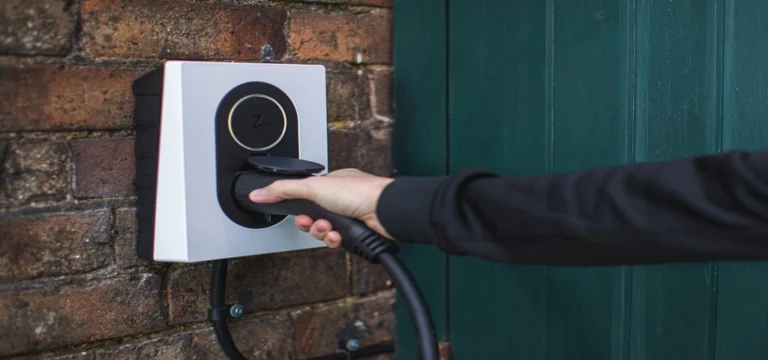
If you’ve just bought your first EV, one of the biggest questions that you’d have is: “Can I plug my electric car into a regular outlet?”
The short answer is yes, you can.
In fact, every EV on the market today comes with a charging cable that works with a standard household outlet.
But while this is the simplest way to charge, it’s not always the fastest or the most convenient.
In this blog, I will explain what exactly happens when you plug your EV into a regular outlet. You’ll learn:
- How long home EV charging takes from a regular outlet
- What safety steps you should keep in mind
- When it makes sense to upgrade to a faster charging
By the end, you’ll know whether a regular electric car power outlet works for you and what options you have if you want more convenience.
So, let’s get started.
Key takeaways
- Yes, you can charge your EV using a standard 120V outlet (Level 1 charging).
- Level 1 charging adds 3-5 miles of range per hour, enough for light daily use.
- Smaller EVs can charge overnight, but big batteries take days.
- Safe charging requires a dedicated circuit and proper outlet setup.
- Avoid extension cords and check for signs of overheating.
- Level 2 chargers offer much faster charging, about 20-30 miles per hour.
- Energy management systems help avoid panel upgrades for Level 2 chargers.
What happens when you plug an EV into a regular outlet?

If you’re wondering whether or not can I plug my electric car into a regular outlet, well you can.
Here’s what happens when you do so.
When you plug your EV into a standard wall charging outlet for car, you’re using what’s called Level 1 charging.
This usually involves using a regular 120-volt outlet, the same kind you’d use for a lamp or phone charger.
Here’s what you can expect when you charge electric car from a regular socket:
- It’s slow but steady: On average, you’ll add about 3 to 5 miles of range per hour. This works out to roughly 30-40 miles from an overnight charge.
- It works fine for light driving: If your daily commute is short or you only drive a few miles around town, charging from a regular outlet can be enough to keep your car topped up.
- Big batteries take longer: For larger EVs (like Teslas or Rivians), a full charge on Level 1 can take several days. This is why many EV owners eventually upgrade to faster charging.
In short: You can think of Level 1 regular outlet charging as an entry point charging. It is simple, easy, and requires no special equipment beyond the charging cable that comes with your car.
However, if you drive more than 30-40 miles a day, you might start to feel the limits pretty quickly.

No More $10k Electrical Panel Upgrade to Charge Your EV at Home
simpleSwitch lets you add a Level 2 EV charger to your home without an expensive electrical panel upgrade. Your EV charges safety without panel overload.

 30-day risk-free returns
- NEMA-rated
- Works with your existing panel
How long does it take electric car to charge from a regular power outlet?
As I said, charging an electric car at home using a regular outlet is slow but steady. Here, the total time it will take your EV depends on two main things:
- Your EV’s battery size
- How much you drive each day
Let me break it down.
1. Smaller EVs (like a Nissan Leaf or Chevy Bolt)

If you have a compact or mid-sized EV like Chevy Bolt with a smaller battery, it is surprisingly workable to charge electric car from a normal socket.
Here’s how it works:
- Plug it in overnight (around 8-10 hours), and you’ll get 30-40 miles of range.
- This is enough to handle most daily commutes or errands.
- However, if your battery is fully depleted, you can expect 30-40 hours to charge EV from a regular socket. So it’s not ideal if you need to charge up in a hurry.
This kind of setup works best if you’re driving less than 40 miles a day and can plug in consistently at night.
2. Larger EVs (like a Tesla Model Y or Rivian R1T)

Big vehicles come with big batteries, which means longer charging times.
So, can you plug an electric car into a regular outlet in this case?
Yes, you can. However, here’s what it means to charge them using a regular home outlet:
- EVs like Teslas can take 60-80 hours (or more) to fully charge from empty.
- Even after a full night of charging, you might only get 15-25 miles of range, which is fine for local errands but not for longer daily commutes.
So, if you’re in a two-car household or only use your EV for short trips, this could still be manageable. But for regular or longer-distance driving, it might start to feel limiting.
Here’s a break-down of regular electric vehicle outlet charging time based on EV model:
| EV Model | Battery Size (kWh) | Miles Added Per Hour | Full Charge Time (Approx.) |
| Nissan Leaf | ~40 kWh | 3-5 miles | ~30-40 hours |
| Chevy Bolt | ~65 kWh | 3-5 miles | ~40-50 hours |
| Tesla Model Y | ~75 kWh | 2-4 miles | ~60-80 hours |
| Rivian R1T | ~135 kWh | 1-3 miles | ~80-100+ hours |
What does this mean for your everyday driving?
Most EV drivers aren’t showing up home every night with a near-empty battery. And here’s what they say about Level 1 charging:
- Many drivers on forums like Reddit and EV owner groups say they do just fine with a regular outlet, especially if they drive under 30 miles a day.
- Instead of charging from 0% to 100%, they just top up the battery each night, similar to charging your phone.
So, if you’re asking yourself can I plug my electric car into a regular outlet, yes you can.
Even if it takes a long time to charge your battery completely, you might rarely need to do so. Just plug in overnight, and your EV will be ready for another day of driving.
Is it enough to charge EV from a regular socket?
Well, whether or not it is enough to charge electric car from a regular socket really depends on how much you drive and where you live.
For instance:
- Do you mostly drive to work, run errands, and pick up the kids?
- Do you have access to public charging for longer trips?
- Can your car sit and charge overnight or during the day while you’re home?
If the answer to any of these is yes, a regular outlet might be all you need to get started, at least for now.
Of course, if your needs grow, or you want more flexibility and speed, there are faster options available. But for many first-time EV owners, starting with Level 1 is practical.
Can I plug my electric car into a regular outlet safely?

Yes, it’s totally safe to charge electric car from a normal socket as long as you take a few basic precautions.
Think of it like plugging in any other high-powered appliance. It is no big deal when everything is set up properly, but you want to make sure the wiring can handle the load.
You see, your EV will draw power for hours at a time, often overnight. And that’s a much heavier and longer load than something like a phone charger or even a microwave.
So it’s worth making sure the outlet and circuit you’re using are up to the task.
Here are some best practices to follow when you charge EV from a regular socket:
1. Use a dedicated circuit
You don’t want your EV sharing a circuit with your fridge, microwave, or washing machine for safety reasons.
Instead here’s what you should do:
- Plug your EV into a dedicated 15-amp or 20-amp circuit. This way your charger gets its own clean and steady supply of power.
- If the electric vehicle outlet is in a garage, basement, or driveway area, it might already be on its own circuit. But it’s worth double-checking.
2. Don’t use extension cords or power strips
Extension cords might be tempting if the cable doesn’t reach your car. But take my advice and resist the urge.
Here’s why:
- Extension cords and power strips are not designed for long-term high-power use. They can overheat and even become a fire hazard.
- If you absolutely must extend the cable, talk to an electrician about installing a proper outdoor-rated outlet closer to where you park.
- You can use a flexible current transformer, but only when it is used along with the required energy management device.
3. Check the outlet condition
Take a close look at the electric vehicle outlet you plan to use.
You should especially look for the following:
- Is it loose, discolored, cracked, or warm to the touch?
- Older homes (especially those built before the 1990s) might have worn wiring or outdated outlets. They aren’t up for the job and you should replace them.
And if you’re in any doubt, I suggest you have a licensed electrician inspect it.
4. Follow the 80% rule
This is an important rule of thumb and it requires that a 15-amp circuit should only be used up to 12 amps continuously.
Why?
That’s because circuits aren’t rated to run at full power for long periods. So, using 80% of the capacity is the safe sweet spot.
Your EV’s charging cable will typically stick to this rule automatically, but it’s good to understand how it works.
5. Watch for warning signs
Once you’ve started charging, stay aware of how things are running.
Stop charging immediately and call an electrician if you notice:
- The outlet or plug feels hot
- You smell something burning or see scorch marks
- The circuit breaker trips repeatedly
These are red flags that the circuit isn’t handling the load safely.
In short, here’s a safety checklist you should follow to charge EV from a regular socket:
| Safety Step | Why It Matters |
| Use a dedicated circuit | Prevents overload and tripped breakers |
| Avoid extension cords/power strips | Reduces fire risk and overheating |
| Inspect outlet condition | Worn or old outlets can be unsafe |
| Follow the 80% rule | Keeps current within safe, continuous load limits |
| Monitor for heat/smells/tripping | Early warning signs of a problem with wiring or load |
| Call an electrician if unsure | Ensures your home setup is safe and up to code |
Bottom line: With the right setup, Level 1 charging is not only safe but also a good starting point for many new EV owners. Just make sure your EV charging outlet is in good shape before using it daily.
How much does it cost to charge your car from a regular electric vehicle outlet?
If you have the time and patience of letting your EV charge slowly from a regular outlet, your charging cost is going to be significantly lower.
You see, the cost to charge EV at home is already way less than getting a tank of gas. And if you’re charging a full EV battery from a regular outlet, it can cost the equivalent of a few dollars per day.
Let’s take this assumption for a better understanding:
- You own a Chevy Bolt that has a has a 60 kWh battery
- Electricity costs in your area are around $0.12-$0.20 per kWh
In this case, a full charge might cost you around $7-$12.
The only catch with Level 1 charging is that it takes longer. But if this isn’t a dealbreaker for you, you’re in for a much affordable EV charging cost.
When should you upgrade to Level 2 EV charging?
While you can charge electric car from a normal socket, many EV owners eventually find themselves wanting something faster and more convenient.
This is when Level 2 charging makes sense.
Level 2 charging uses a 240-volt outlet, similar to what you’d plug an electric dryer or oven into.
And instead of just 3-5 miles of range per hour, it gives you 20-30 miles for every hour of charging. This is enough to fully recharge most EVs overnight.
All in all, you might want to consider upgrading to Level 2 if:
- You regularly drive more than 30-40 miles a day.
- You own a larger EV with a big battery.
- You share the car with other drivers in your household.
- You prefer the peace of mind of waking up to a full battery every morning.
Here’s a comparison of Level 1 vs Level 2 charging:

| Feature | Level 1 Charging (120V) | Level 2 Charging (240V) |
| Outlet Type | Standard household outlet | Dryer/oven-style outlet |
| Charging Speed | 3-5 miles of range per hour | 20-30 miles of range per hour |
| Full Charge Time (Small EV) | 30-40 hours | 6-10 hours |
| Full Charge Time (Large EV) | 60-80+ hours | 10-12 hours |
| Equipment Needed | Comes with the car | Requires purchase and installation |
| Best For | Light daily driving (less than 40 miles) | Daily long commutes, faster needs |
Bonus: You need not upgrade electrical panel for Level 2 charging
Yes, that’s right.
You see, not every home’s electrical panel has enough spare capacity to handle a Level 2 charger. And a panel upgrade for EV charging can be both expensive and time consuming.
Thankfully, there are smart energy management systems (EMS) that help you skip panel upgrades altogether.
Here, a device like simpleSwitch will monitor your home’s electricity use in real time and use a whole-home circuit sharing approach to safely charge your EV.

Here’s what it does:
- It keeps track of your home’s total electrical usage in real time
- If your panel starts to reach 80% of its capacity, the system will automatically pause EV charging to prevent overload
- Once your home’s energy usage drops below 80% of panel capacity, charging safely resumes without you lifting a finger
As long as your charger is set to 48 amps or less, a device like this can keep everything running smoothly. Your lights stay on, your appliances run as usual, and your car charges efficiently in the background.
No More $10k Electrical Panel Upgrade to Charge Your EV at Home
simpleSwitch lets you add a Level 2 EV charger to your home without an expensive electrical panel upgrade. Your EV charges safety without panel overload.
- 30-day risk-free returns
- NEMA-rated
- Works with your existing panel
Conclusion
By now, you have clear answers to your biggest question: Can I plug my electric car into a regular outlet?
Yes, you can indeed plug an electric car into a regular outlet. In fact, for many drivers, this is the easiest way to start with EV charging.
Level 1 charging works well if your daily mileage is low, and it’s safe as long as your outlet and wiring are in good shape.
But that said, as your driving needs grow, you might find yourself wanting the speed and convenience of Level 2 charging.
The good news is you don’t always need a costly electrical panel upgrade to make that happen, with an EV energy management system like simpleSwitch, you can safely add a faster charger while keeping your home running smoothly.
Need to install an EMS to charge your EV at home?
simpleSwitch helps you avoid costly panel upgrades with whole-home circuit sharing. Our automatic load management system keeps your house running smoothly while charging your EV efficiently. You get faster, safer, and stress-free charging every day.
FAQs about charging your EV from a regular outlet
Can I plug my EV into a normal 120V outlet?
Yes, you can charge electric cars with 120V outlets.
You see, every EV sold today includes a charging cable designed for a standard 120V outlet. This is called Level 1 charging.
It is the slowest charging method, but it works for many drivers who don’t rack up a lot of daily miles.
How much range do I get per hour on a regular outlet?
On average, you’ll add 3-5 miles of range per hour.
This means an overnight charge can give you 30-40 miles. It is enough for most commutes or local driving.
Is it safe to use a regular outlet for charging?
Yes, it is safe to plug your car charger to regular outlet if done properly.
The outlet should be in good condition, on a dedicated circuit, and inspected by an electrician if your wiring is old.
Avoid using extension cords or power strips. Also, keep an eye out for warning signs like a hot outlet or tripped breaker.
Does weather affect EV charging from a regular outlet?
Yes, it does.
Charging your EV from a regular outlet can be affected by weather, especially in extreme conditions.
Here’s how:
- Cold weather can slow down charging and reduce battery efficiency
- Hot weather might increase energy losses slightly
- Your EV might use extra energy to heat or cool the battery while charging
So, if you live in an area with extreme temperatures, upgrading to Level 2 can help offset this.
Will charging from a regular outlet damage my car battery?
No.
Your car’s onboard charging system manages the process safely. Charging from a regular outlet is just slower, not harmful.
In fact, Level 1 charging generates less heat, which some say can be easier on the battery long-term.
Do I need a special outlet to use Level 1 charging?
No special outlet is needed.
A regular grounded household outlet works fine, as long as it’s in good shape and on a circuit that can handle the continuous load.
Do I need a special charger for my electric car?
No, you don’t.
Your EV already comes with a standard charging cable that’s designed to plug into a regular household outlet.
This allows you to start charging right away using Level 1 charging, without needing to buy any additional equipment.
Can you plug a Tesla into a regular outlet?
Yes, you can plug a Tesla into a regular household outlet using the charging cable that comes with the car.
Your EV will use a standard 120V outlet for charging. It is safe as well as convenient.
But the only catch is slow charging. Here, you’re typically adding about 2-4 miles of range per hour.
It works well for light daily driving, but for faster charging, most owners eventually upgrade to a Level 2 setup.
Can I leave my EV plugged in overnight?
Absolutely.
In fact, that’s the most common way to use Level 1 charging. Just make sure the outlet and circuit are safe, and let your car’s charging system handle the rest.
EVs are designed to stop charging automatically once the battery is full.
Should I upgrade to Level 2 if I only drive 20-30 miles a day?
Not necessarily.
If your driving is light, Level 1 may cover your needs.
But if you want faster charging, more convenience, or if your household has multiple EVs, a Level 2 charger is worth considering.