If you are thinking about buying an electric vehicle, regenerative braking is one of those features you should definitely pay attention to.
You see, almost every EV today comes with regenerative braking. But that doesn’t mean they all feel the same when you take your foot off the accelerator.
Some EVs slow down immediately, almost bringing the car to a complete stop without touching the brake pedal. Others let the vehicle coast more naturally, just like a traditional gas car. And then there are EVs that let you adjust how strongly the vehicle slows down.
So, which electric vehicles have the best regenerative braking in, and, are there any models you might want to avoid if you prefer strong one-pedal driving?
In this blog, I have sought to answer exactly that by comparing the most popular electric vehicles with regenerative braking for their regen strength, driving experience, and online owner feedback.
So, let’s get into it.
Key takeaways
- Almost all modern battery-electric vehicles have regenerative braking, but their driving experience is different.
- Some EVs offer strong one-pedal driving, while others are designed to coast more naturally.
- Stronger regenerative braking doesn’t mean significantly more driving range.
- Regeneration can be limited when the battery is cold or nearly fully charged.
- The best EV depends on how you prefer your vehicle to slow down, not simply how strong its regen setting is.
First, what makes a good regenerative braking system?
Before we compare different EVs, let’s get one thing straight. A good regenerative braking system isn’t the one that slows the vehicle down the fastest.
Yes, for some drivers, strong one-pedal driving is a big advantage. They like being able to control acceleration and deceleration mostly through the accelerator pedal.
But there are other drivers who prefer their EV to coast when they release the accelerator and use the brake pedal when they actually need to slow down.
Both preferences are perfectly reasonable. That’s why when comparing EVs, I personally focus on five things:
- Regen strength: How strongly does the vehicle slow down when you release the accelerator.
- Adjustability: Can you choose between different levels of regenerative braking.
- One-pedal driving: Can the vehicle slow down and come to a stop using the accelerator pedal alone under normal conditions.
- Smoothness: Does the vehicle slow down naturally, without jerking or sudden changes.
- Brake-pedal feel: Does the transition between regenerative braking and conventional braking feel natural.
These are the things that make for a good regenerative braking system rather than how quickly your EV can come to a halt and how much energy it can recover.

No More $10k Electrical Panel Upgrade to Charge Your EV at Home
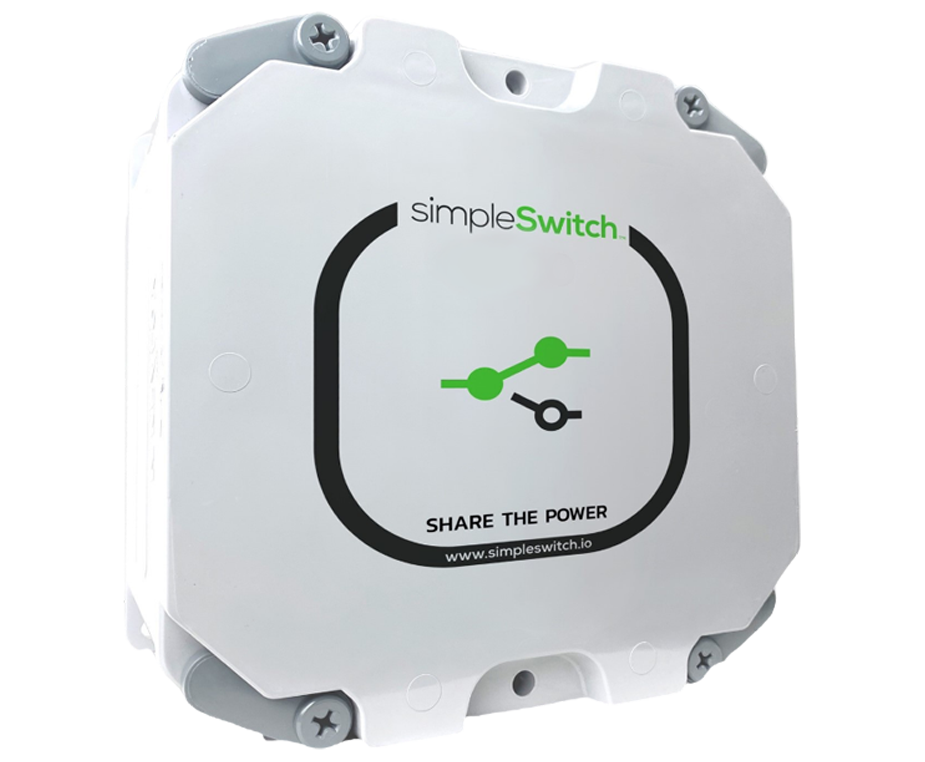
simpleSwitch lets you add a Level 2 EV charger to your home without an expensive electrical panel upgrade. Your EV charges safety without panel overload.
 30-day risk-free returns
- NEMA-rated
- Works with your existing panel
Here are some of the best electric vehicles with regenerative braking
If you’re looking for a quick answer, here are some EVs that truly stand out for their regenerative braking features and driving experience.
| Electric vehicle | What makes its regen stand out |
| Tesla Model 3 | Smooth accelerator-lift regeneration |
| Hyundai IONIQ 5 | Adjustable regen with steering-wheel paddles |
| Kia EV6 | Multiple regen levels and one-pedal driving |
| Chevrolet Equinox EV | Adjustable one-pedal driving strength |
| Ford Mustang Mach-E | Dedicated one-pedal driving mode |
| Nissan LEAF | Adjustable regen and e-Step technology |
Now, let’s take a closer look at what makes each of these EVs worth your money.
#1. Tesla Model 3: Best overall regenerative braking experience
Just like an early bird among EVs with NACS charging port, Tesla also made one of the first cars with regenerative braking.
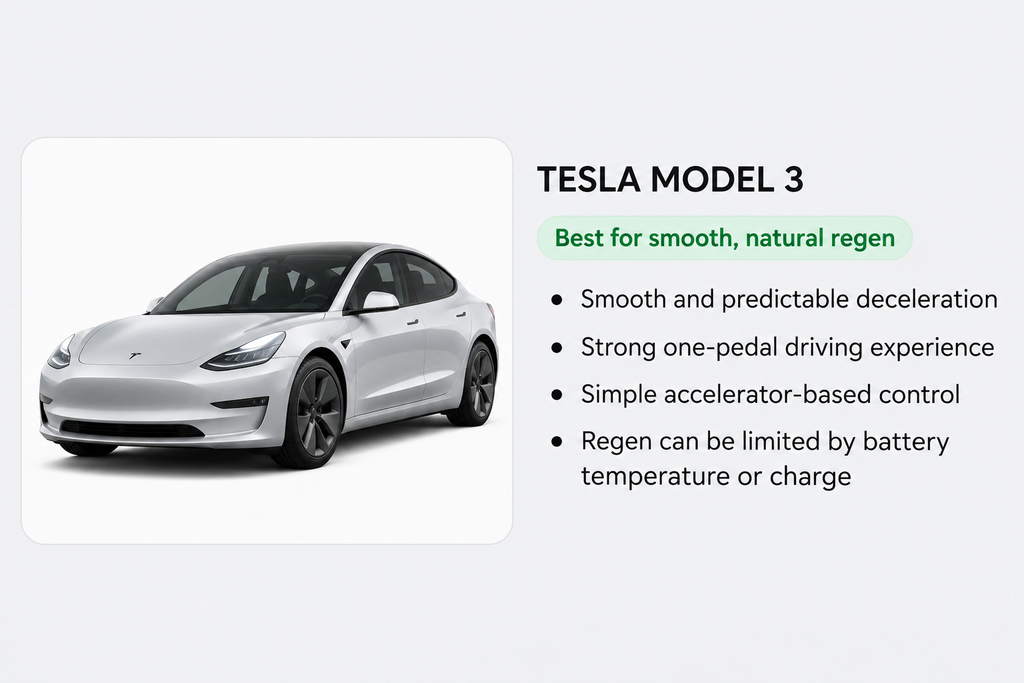
And the Tesla Model 3 is one of the best examples of an EV that makes regenerative braking feel like a natural part of driving.
Whenever you release the accelerator, the electric motor slows the vehicle down and sends recovered energy back to the battery.
The experience is smooth and predictable, especially once you get used to how quickly the vehicle decelerates.
One thing worth mentioning is that Tesla’s system doesn’t require you to keep switching between several regen levels while driving. The vehicle manages regenerative braking as you lift off the accelerator, while the regular brake pedal remains available whenever you need it.
However, regen isn’t always available at the same strength. As per Tesla, regenerative braking can be limited on this EV when the battery is cold or already fully charged.
Why it stands out: Its smooth accelerator-lift deceleration makes regenerative braking easy to use during everyday driving.
What you should consider: Drivers who prefer their EV to coast freely when they release the accelerator might need some time to get used to Tesla’s driving feel.
#2. Hyundai IONIQ 5: Best for adjustable regenerative braking
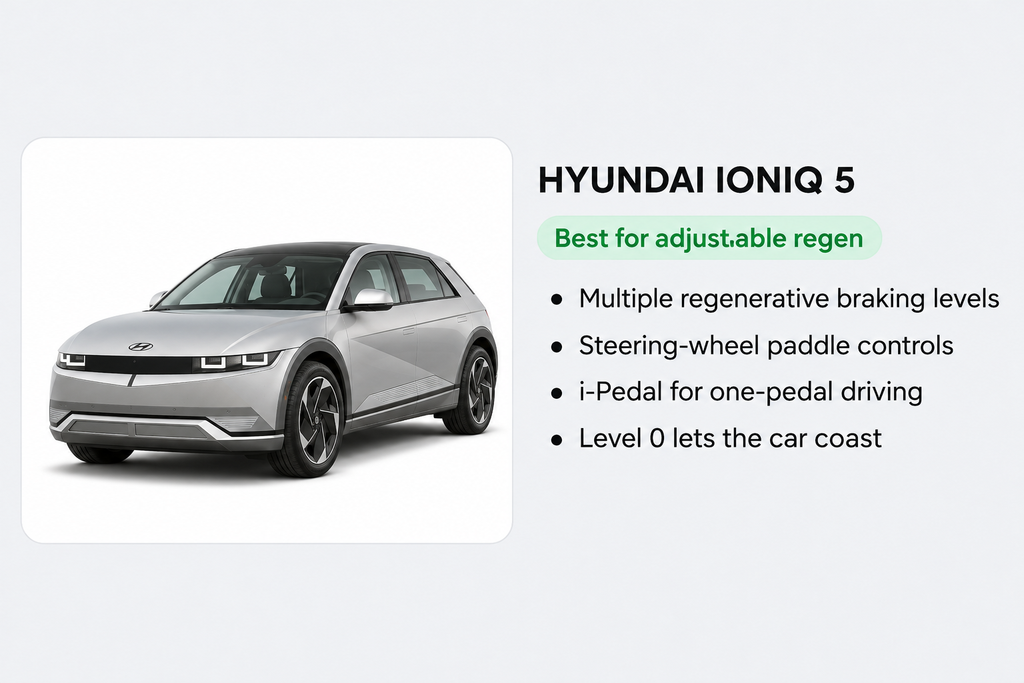
If you like having control over how strongly your EV slows down, the Hyundai IONIQ 5 is worth considering.
Hyundai gives drivers steering-wheel paddle shifters to adjust regenerative braking. Just pull the left paddle to increase regen and the right paddle to reduce it.
You can also choose between different regeneration levels, including a setting that lets the vehicle coast with very little regenerative braking.
And that’s not all.
The IONIQ 5 also offers i-Pedal, Hyundai’s one-pedal driving feature. Hold the left paddle to activate it, and the vehicle can slow down and come to a stop using regenerative braking.
This makes the IONIQ 5 a good option for drivers who want to experiment with different braking strengths rather than being stuck with one driving feel.
Why it stands out: You get multiple regen settings, steering-wheel controls, and one-pedal driving.
What you should consider: The system has operating limitations, and drivers must still use the brake pedal when necessary.
#3. Kia EV6: Best for drivers who want multiple regen controls
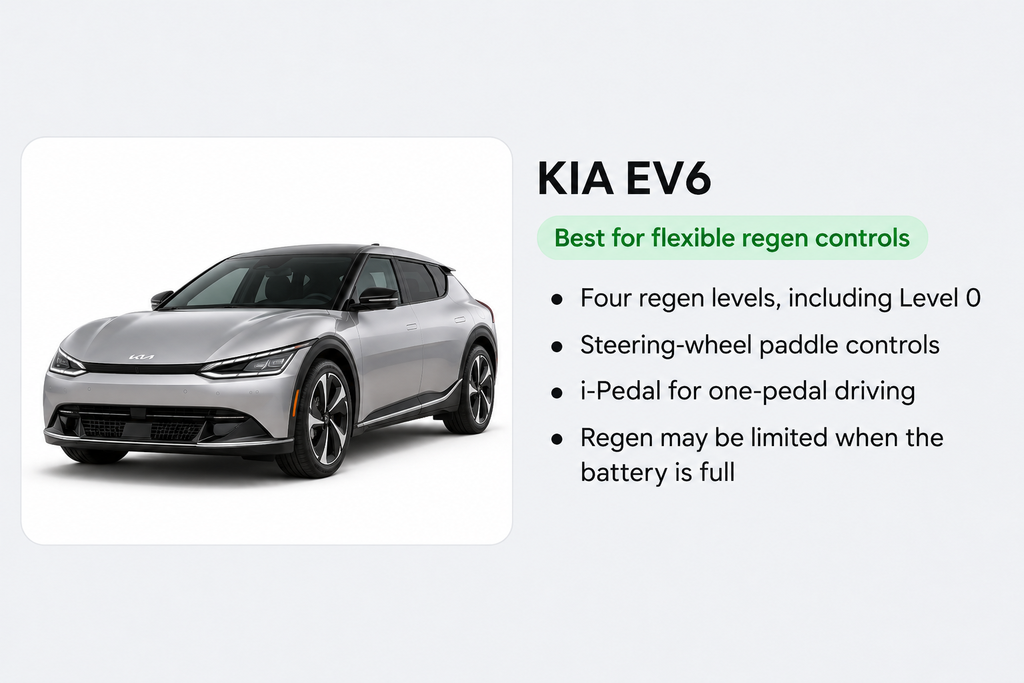
The Kia EV6 takes a similar approach to the Hyundai IONIQ 5. In fact, both vehicles offer adjustable regenerative braking through steering-wheel paddles.
The EV6 lets drivers select different levels of regeneration, from little or no regenerative braking to stronger deceleration. You can also hold the left paddle to activate one-pedal driving.
This is useful because you don’t have to rely on one fixed setting for every situation. For instance, you might prefer lighter regen when driving on the highway but stronger regeneration when navigating stop-and-go traffic.
Kia also offers an i-Pedal feature on equipped models, allowing the driver to control acceleration and deceleration through the accelerator pedal.
Why it stands out: Its adjustable regen levels and one-pedal driving give drivers plenty of control over how the vehicle slows down.
What you should consider: Regenerative braking can be restricted when the battery is fully charged, and drivers should never rely on one-pedal driving alone to stop in every situation.
#4. Chevrolet Equinox EV: Best for a smooth one-pedal driving experience
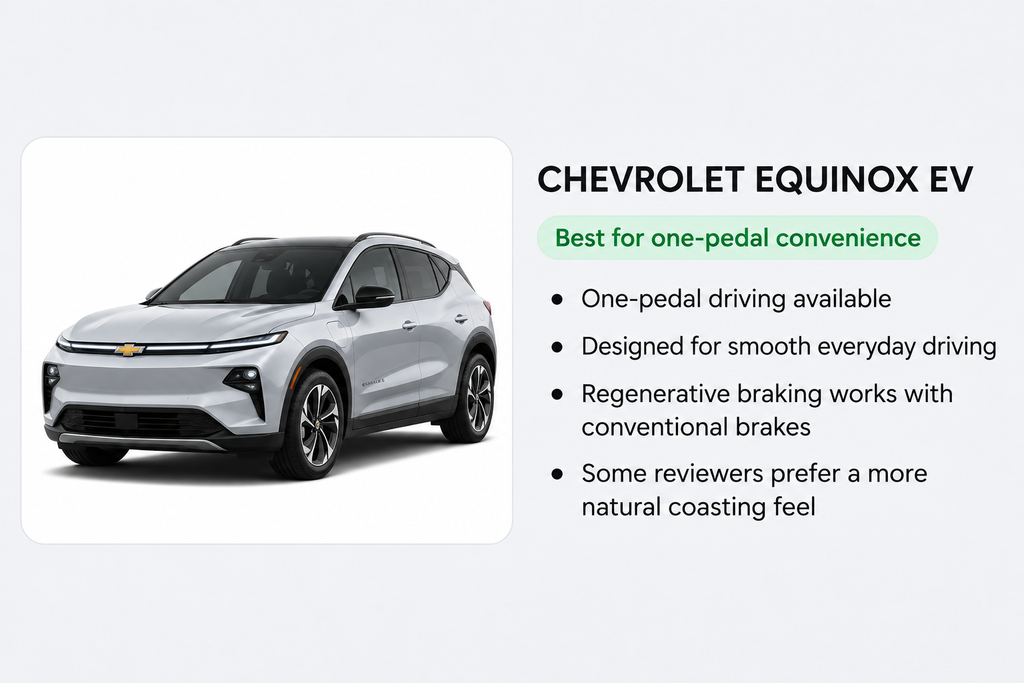
The Chevrolet Equinox EV made a place on this list because of its one-pedal driving feature. It allows the vehicle to slow down when you release the accelerator, using regenerative braking to recover some of the energy that would otherwise be lost as heat. Also, drivers can adjust the strength of one-pedal driving to suit their preferences.
However, there’s an interesting difference of opinion about how this system feels.
Some drivers I have talked to praised its smooth deceleration and brake-pedal feel. But then, others criticized the lack of natural coasting, especially when they want a more traditional driving experience.
And that’s something you should keep in mind. After all, a strong regenerative braking system might feel great to one driver but unnecessarily aggressive to another.
Why it stands out: It offers one-pedal driving with adjustable deceleration strength.
What you should consider: If you prefer your EV to coast naturally when you release the accelerator, take a proper test drive before deciding.
#5. Ford Mustang Mach-E: Best for a dedicated one-pedal driving mode
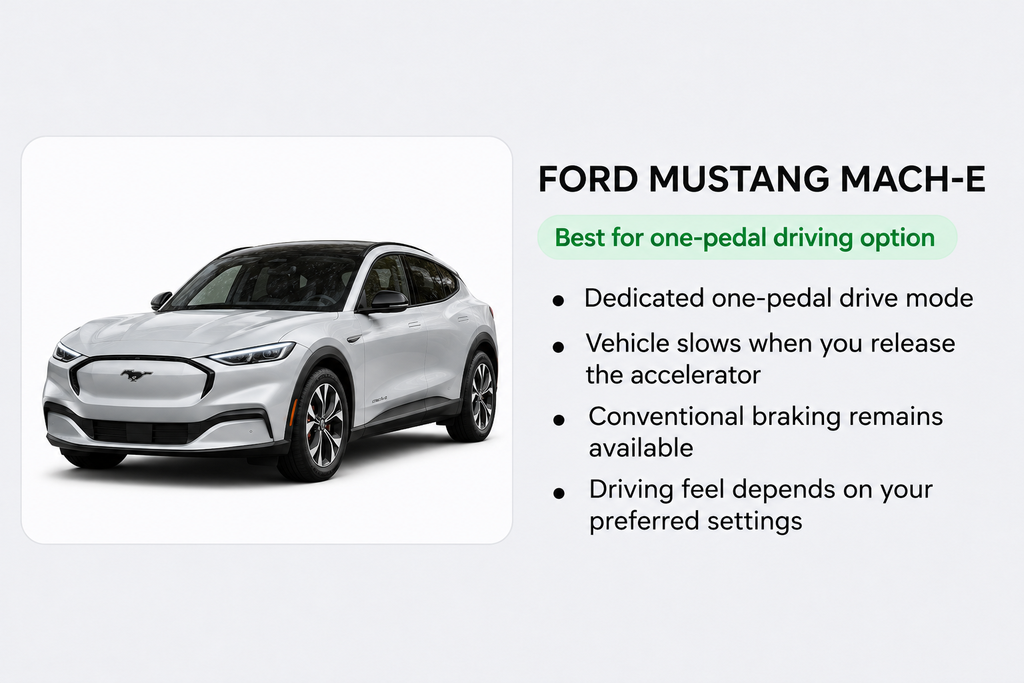
The Ford Mustang Mach-E is another EV worth checking out if you enjoy one-pedal driving.
Ford offers a dedicated One-Pedal Drive setting that allows the vehicle to slow down as you lift off the accelerator.
Here, instead of repeatedly switching between the accelerator and brake pedals in everyday traffic, you can control much of the vehicle’s speed using the accelerator. This can make stop-and-go driving feel more convenient once you get used to the system.
However, one-pedal driving isn’t necessarily for everyone. And if you’re used to allowing your car to coast, the stronger deceleration can take some getting used to.
Why it stands out: Its dedicated one-pedal driving mode makes regenerative braking easy to understand and use.
What you should consider: Test the deceleration before buying, especially if you prefer a conventional coasting experience.
#6. Nissan LEAF: A good option for customizable regenerative braking
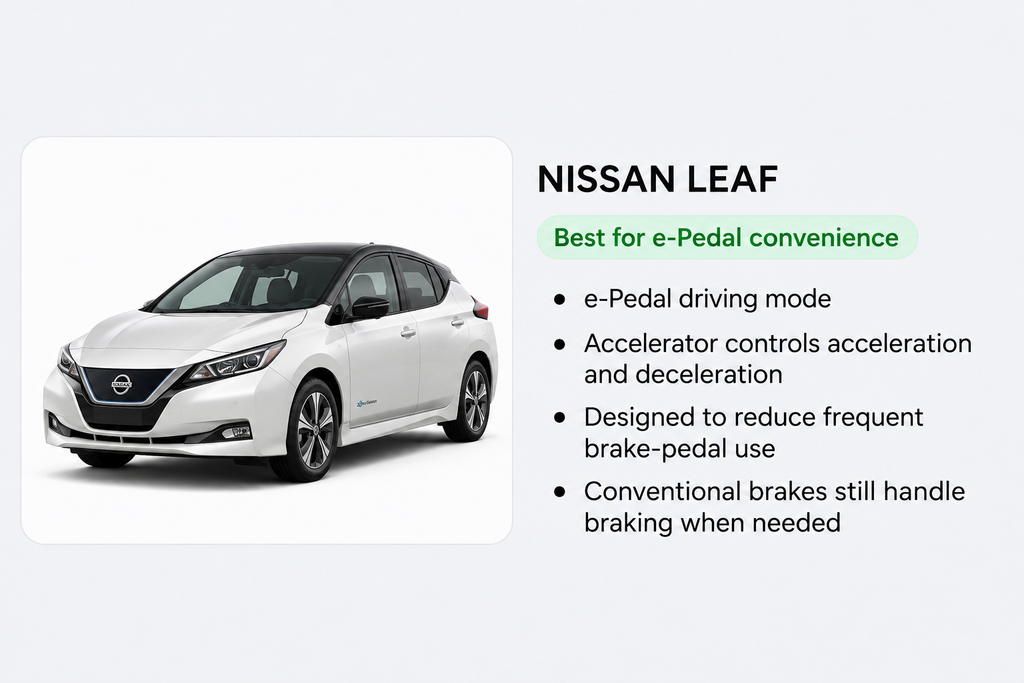
Nissan LEAF is already a favorite among those drivers who want a lower cost to charge an electric car at home, thanks to its efficiency. And it is also one of those EVs that has been using regenerative braking technology for years.
Here, Nissan’s e-Pedal technology allows drivers to slow down and bring the vehicle to a stop primarily through accelerator-pedal control.
The re-designed 2026 LEAF continues to offer regenerative braking features, although I suggest you check the exact equipment and operation for your selected model.
What’s interesting about the LEAF is that its braking experience has evolved over different generations.
The older 2018 LEAF received a lot of criticism for its low-speed braking feel. However, that’s not true anymore for the redesigned 2026 model.
Why it stands out: Its e-Step technology provides a one-pedal driving experience.
What you should consider: Don’t judge the newer LEAF by reviews of older generations. Test the current model yourself before making a decision.
Which EVs have the least impressive regenerative braking?
Now, let’s look at the electric vehicles with regenerative braking that don’t seem to bode well with drivers, and for good reasons.
These are vehicles with less aggressive regenerative braking. And they in no way have a bad or unsafe braking system. It is just that their driving experience doesn’t suit someone who wants strong one-pedal driving.
Here are two cars with regenerative braking that drivers particularly gave bad reviews to:
#1. Volkswagen ID.4: Not ideal if you want strong one-pedal driving
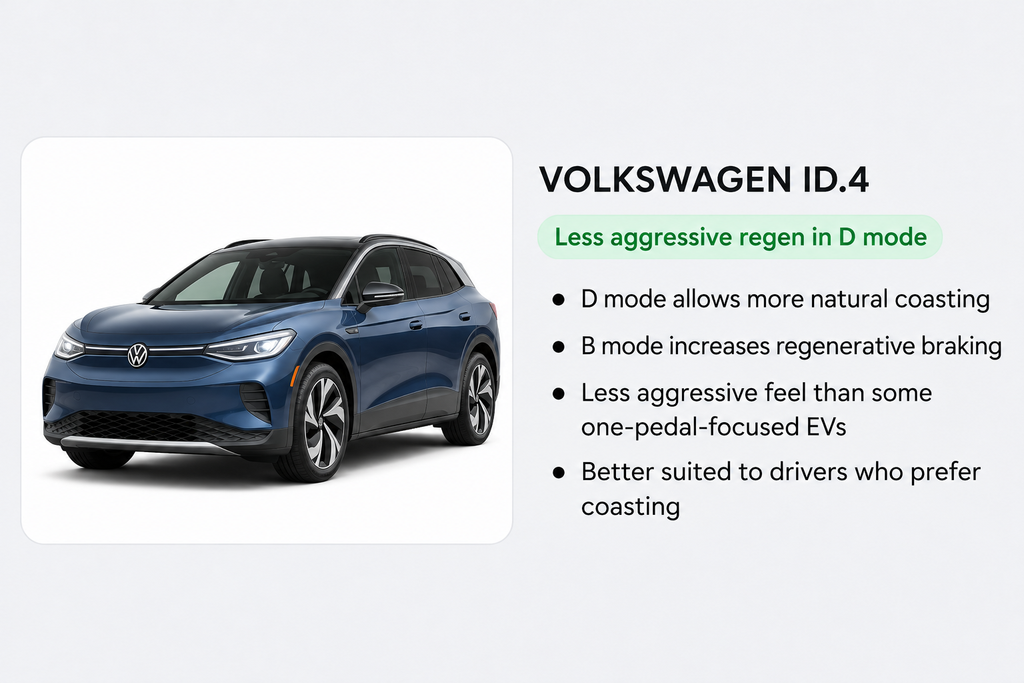
The Volkswagen ID.4 is an interesting example. Unlike some EVs that strongly slow down when you release the accelerator, the ID.4 offers a more conventional coasting experience in its D driving mode. Its B mode provides stronger energy recuperation when slowing down.
This works well for drivers who don’t want aggressive deceleration every time they lift their foot from the accelerator.
However, if you’re looking for a strong one-pedal driving experience, the ID.4 may feel less responsive than alternatives such as the Hyundai IONIQ 5 or Kia EV6.
My take: The ID.4 isn’t necessarily a bad EV for regenerative braking. It’s simply a less obvious choice for drivers who prefer strong, adjustable one-pedal driving.
#2. Chevrolet Equinox EV: Not everyone’s preferred coasting experience
The Equinox EV is hated by some EV drivers for the very reason why other EV drivers love it.
As I said earlier, some of the drivers I talked to appreciated its smooth one-pedal driving. But then the other drivers who have Equinox EV said they prefer a more natural coasting feel.
So, it’s difficult to call it one of the worst EVs for regenerative braking. Instead, I would consider it a vehicle that you should test-drive before buying, especially if you have strong preferences about how your car slows down.
Why do regenerative braking systems feel different in different EVs?
You might be wondering: if all these EVs use regenerative braking, why does one slow down immediately while another continues to coast?
Well, it comes down to how each manufacturer has designed its electric car braking system.
There are three main differences here that you should know about:
A. Different levels of regenerative braking
Some EVs apply strong regeneration as soon as you release the accelerator. Others use lighter regeneration, allowing the vehicle to coast farther.
B. Different ways of controlling regen
Some manufacturers use steering-wheel paddles, while others provide settings through the vehicle’s touchscreen or driving modes. Certain EVs also adjust regeneration automatically based on driving conditions.
C. Different braking systems and brake blending
EVs use both regenerative braking and conventional friction brakes. When you press the brake pedal, the vehicle can use regenerative braking first and then apply conventional brakes as needed.
The way these two systems work together differs between vehicles. That’s one reason the brake pedal feels different from one EV to another.
Does stronger regenerative braking give you more driving range?
Not necessarily.
And this is one of the biggest misconceptions about regenerative braking.
Some EV owners believe that selecting the strongest regen setting will automatically give them significantly more driving range. But that’s not how it works.
You see, regenerative braking recovers some of the energy that would otherwise be lost when your vehicle slows down. But you don’t get all that energy back.
For instance, if you accelerate quickly and then immediately slow down using strong regenerative braking, you’ve already used energy to accelerate. The braking system can recover only a portion of it.
On the other hand, if you anticipate traffic, accelerate smoothly, and avoid unnecessary braking, you might use less energy in the first place.
So, your end goal shouldn’t be to use the strongest regen setting all the time. It should instead be to drive efficiently and recover energy whenever slowing down is necessary.
No More $10k Electrical Panel Upgrade to Charge Your EV at Home
simpleSwitch lets you add a Level 2 EV charger to your home without an expensive electrical panel upgrade. Your EV charges safety without panel overload.
- 30-day risk-free returns
- NEMA-rated
- Works with your existing panel
Final words
By now, you should have a good understanding of the best electric vehicles with regenerative braking and the not so ideal candidates.
The Tesla Model 3, Hyundai IONIQ 5, and Kia EV6 are all worth your investment if you want a well-developed regenerative-braking experience.
The Chevrolet Equinox EV, Ford Mustang Mach-E, and Nissan LEAF are also good options with one-pedal or adjustable regen features.
My only suggestion is to not go after the strongest regenerative braking system. Instead see how naturally the vehicle slows down, how much control you have, and whether you enjoy the driving experience before deciding to put your money into an EV.
Got more questions or want to install a Level 2 EV charger at home instead?
You can get in touch with us!
At simpleSwitch, we manufacture state-of-the-art EV load sharing devices that let you use a Level 2 EV charger at home safely and efficiently without upgrading your electrical panel. This saves you up-to $10,000 in unnecessary electrical panel upgrades.
Our load sharing devices are all UL-listed and proudly manufactured in the USA.
You might also want to read: The 8 Best Home EV Level 2 Charger Models.
FAQs about electric vehicles with regenerative braking
Do all electric cars have regenerative braking?
Almost all modern battery-electric vehicles use regenerative braking. However, the strength, controls, and driving experience differ by manufacturer and model.
Which EV has the strongest regenerative braking?
There isn’t one universal winner because manufacturers use different settings and measurements. Tesla, Hyundai, and Kia offer strong regenerative-braking experiences, including one-pedal driving options on applicable models.
Which electric car has the smoothest regenerative braking?
Although smoothness is subjective, most of the drivers I talked to give the Tesla Model 3 positive feedback for its natural deceleration.
But then, my advice is to always trust your experience by test-driving a vehicle and decide what feels best to you.
Can regenerative braking bring an EV to a complete stop?
Some EVs offer one-pedal driving that can bring the vehicle to a stop under normal conditions. However, drivers should still be prepared to use the conventional brake pedal whenever necessary.
Does regenerative braking increase EV range?
Yes, it can help recover some energy and improve efficiency. However, the amount recovered depends on driving conditions, speed, battery temperature, and how the vehicle is driven.
Do electric cars still use regular brakes?
Yes. EVs still have conventional friction brakes, which work alongside regenerative braking. They remain essential for emergency stops, situations where regen is limited, and other braking needs.
Do hybrid cars have regenerative braking?
Yes. Many conventional hybrid and plug-in hybrid vehicles use regenerative braking to recover energy and store it in their batteries. The system helps improve overall vehicle efficiency.