If you’ve been following the EV industry lately, you’ve probably noticed one thing: Electric vehicles are evolving way faster than most people expected.
A few years ago, the innovations were mostly about driving range and charging availability. But today, the industry is moving far beyond that.
We’re now seeing smarter batteries, faster charging systems, connected vehicles, and even technologies that allow EVs to power homes.
Simply put, electric vehicles are no longer just replacing gas-powered cars, they’re becoming part of a much larger transportation and energy ecosystem.
Now, you might be wondering: What are the biggest electric vehicle innovations right now?
And most importantly how will these innovations impact how you drive?
In this blog, I have explained it all.
Read on, as I explain the latest advancements in electric cars and how they’re changing the way we drive, charge, and interact with our vehicles.
Key takeaways
- Solid-state batteries are significantly improving EV range and safety
- Ultra-fast charging is making EV charging quicker and more convenient
- Vehicle-to-Grid (V2G) technology is turning EVs into energy resources
- Wireless charging could make charging almost effortless
- AI-powered systems are helping EVs use energy more efficiently
Are electric vehicle innovations really advancing that fast?

Short answer: Yes.
In fact, many of the EV advancements that experts expected to arrive years from now are already being tested or rolled out today.
For instance, the latest EV charging trends are seeing battery technology improve rapidly.
Also, charging networks are expanding across the country. And vehicles are becoming smarter through software, AI, and real-time connectivity.
For EV owners, this means one thing: The driving experience is getting better, more convenient, and more efficient with every new generation of electric vehicles.
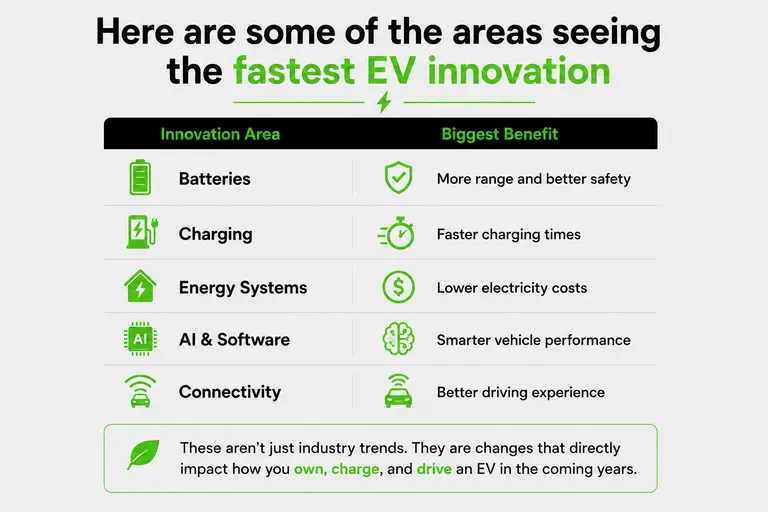
Here are the top 10 electric vehicle innovations in 2026
1. Solid-state batteries are increasing EV range and safety
One of the most exciting electric vehicle innovations today is the development of solid-state batteries.
Traditional EV batteries use liquid electrolytes to move energy between cells. Solid-state batteries replace those liquids with solid materials.
That might sound like a small change, but the impact is huge. Compared to current lithium-ion batteries, solid-state batteries have the potential to:
- Store more energy in the same amount of space
- Deliver longer driving range
- Charge faster
- Improve battery safety
- Reduce the risk of overheating
For EV owners, this means fewer charging stops and more confidence during long trips.
Now, solid-state batteries are still being developed and refined. But automakers already see them as one of the most important technologies in electric vehicles.

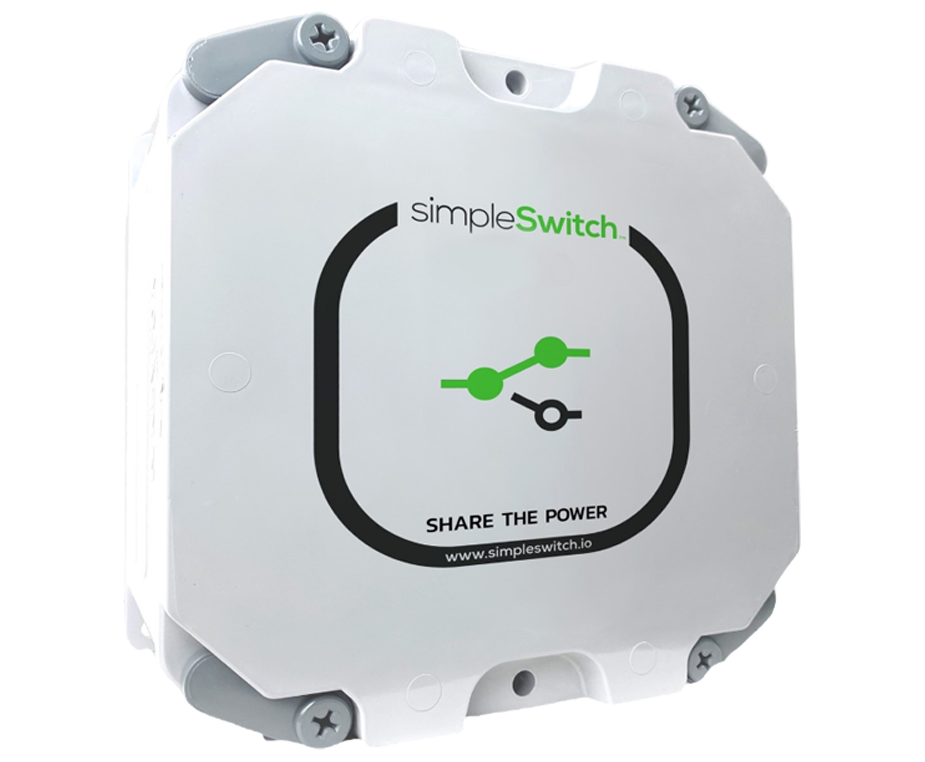
No More $10k Electrical Panel Upgrade to Charge Your EV at Home
simpleSwitch lets you add a Level 2 EV charger to your home without an expensive electrical panel upgrade. Your EV charges safety without panel overload.
 30-day risk-free returns
- NEMA-rated
- Works with your existing panel
2. Ultra-fast charging is reducing charging times dramatically
Charging speed has always been one of the biggest concerns for EV drivers. So much so that the biggest question new EV buyers always had is how long it takes to charge an EV.
After all, nobody wants to spend hours waiting for their vehicle to recharge.
Now, EV charging technology is improving quickly. New ultra-fast charging stations are capable of delivering significantly more power than traditional charging systems.
So much so that some EVs can recover hundreds of miles of range in a matter of minutes rather than hours.
Overall, here’s what you can expect from the new ultra-fast chargers:
- Shorter charging stops
- Greater convenience during road trips
- Less range anxiety
- A more seamless driving experience
3. Vehicle-to-grid is turning EVs into energy assets
What if your EV could do more than just consume electricity?
With vehicle-to-grid (V2G) technology, that’s exactly what’s happening.
V2G allows an electric vehicle to send stored electricity back to the power grid when needed.
This creates benefits for both EV owners and utility companies. For instance, your EV can:
- Help stabilize the grid during periods of high demand
- Store energy when electricity is cheaper
- Supply power when energy prices rise
- Create new ways to save on utility
Also, another technology called vehicle-to-home (V2H) even allows your EV to power parts of your home during an outage.
In short, with these innovations, your EV might soon become one of the most valuable energy devices in your home.
4. Wireless EV chargers are making charging more convenient
Imagine parking your EV and having it start charging automatically.
You need no cables, no plugs, no extra steps.
That’s exactly what wireless EV chargers promise.
Wireless charging uses electromagnetic fields to transfer energy between a charging pad installed on the ground and a receiver mounted underneath the vehicle.
The process works automatically whenever the vehicle is positioned correctly over the charging pad.
This technology brings several benefits, including:
- Greater convenience for daily charging
- Reduced wear on charging connectors
- Improved accessibility for drivers with mobility limitations
- A cleaner and simpler charging experience
Wireless charging is still in the early stages of adoption in some commercial properties. But it is only a matter of time that even the best home Level 2 EV chargers could offer this feature.
5. AI-powered energy management is making EVs smarter
AI is becoming a major part of modern EV car technology. And no, I am not just talking about self-driving features.
Today, AI is helping electric vehicles make smarter decisions about how they use energy. For instance, AI-powered systems can analyze:
- Driving habits
- Traffic conditions
- Route information
- Weather patterns
- Battery performance
Your EV can then use this information to optimize energy consumption and improve efficiency. This will help you get more out of every charge.
Not to mention, AI can even recommend the best charging times, predict battery health issues, and improve charging performance over time.
Simply put, EVs in the near-future won’t just be electric. They’ll be intelligent too.
6. Autonomous driving systems are becoming more advanced
Another area seeing rapid innovation is autonomous driving technology.
While fully self-driving private vehicles are still a work in progress, today’s driver-assistance systems are already far more capable than they were just a few years ago.
Modern EVs use cameras, sensors, radar, and artificial intelligence to assist with:
- Lane keeping
- Adaptive cruise control
- Automatic braking
- Traffic monitoring
- Parking assistance
These features make driving safer and less stressful, especially during long commutes or highway travel.
And as software and sensor technology continue to improve, autonomous capabilities are expected to become even more sophisticated.
Of course, you are still responsible for operating your vehicle. But there’s no doubt that autonomous technology is one of the most significant recent EV advancements shaping the future of mobility.
7. Connected vehicles and over-the-air updates are changing EV ownership
Think about how often your smartphone receives updates.
Now imagine your vehicle doing the same thing.
That’s exactly what’s happening with connected EVs.
Many modern electric vehicles receive over-the-air (OTA) software updates that improve vehicle performance, add new features, and fix issues without requiring a visit to a service center.
This offers several advantages like:
- Improved vehicle functionality
- Better security features
- Faster bug fixes
- New features added after purchase
In other words, your EV can continue improving long after you drive it off the lot.
8. Modular EV platforms are accelerating innovation
Building different vehicle models used to require entirely different vehicle architectures.
But that’s starting to change.
Many automakers are now using modular EV platforms.
A modular platform is essentially a flexible vehicle foundation that can support multiple vehicle types using the same underlying structure.
This allows manufacturers to build sedans, SUVs, pickup trucks, and commercial vehicles, all using a common platform.
The benefits are significant. For manufacturers this means:
- Faster development cycles
- Lower production costs
- Improved scalability
And for consumers, this results in:
- More EV choices
- Faster innovation
- Better affordability over time
This might not be the most visible electric vehicle innovation from a driver’s perspective. But behind the scenes, it’s helping remove barriers to EV adoption across the entire industry.
9. Battery recycling and sustainable materials are becoming better
As more EVs hit the road, another important challenge is getting attention: What happens to batteries at the end of their life?
The good news is that the industry is investing heavily in battery recycling and sustainable manufacturing.
New recycling technologies are making it possible to recover valuable materials such as:
- Lithium
- Nickel
- Cobalt
- Copper
These materials can then be reused in future batteries.
At the same time, automakers are trying to use more sustainable materials throughout the vehicle manufacturing process. This includes:
- Recycled plastics
- Renewable materials
- Lower-emission production methods
These advancements in electric vehicles aren’t just improving performance. They’re also helping make EVs more environmentally responsible throughout their entire lifecycle.
10. Vehicle-to-everything (V2X) communication is improving road safety
The final innovation on this list focuses on communication; specifically, communication between vehicles and the world around them. This technology is known as vehicle-to-everything, or V2X.
V2X allows vehicles to exchange information with:
- Other vehicles
- Traffic signals
- Road infrastructure
- Pedestrians
- Transportation networks
The goal is simple: Help vehicles make better decisions in real time.
For instance, a connected vehicle can receive alerts about:
- Traffic congestion ahead
- Road hazards
- Construction zones
- Sudden braking by nearby vehicles
This can improve safety, reduce traffic delays, and create a more efficient transportation system.
In short, here are the top electric vehicle innovations:
| Innovation | What it means |
| Solid-state batteries | More range and improved safety |
| Ultra-fast charging | Much shorter charging times |
| Vehicle-to-Grid (V2G) | EVs can supply energy back |
| Wireless charging | More convenient charging |
| AI-powered energy management | Smarter energy usage |
| Autonomous driving systems | Better driver assistance |
| OTA updates | Continuous vehicle improvements |
| Modular EV platforms | Faster EV development |
| Battery recycling | More sustainable EV production |
| V2X communication | Safer and smarter transportation |
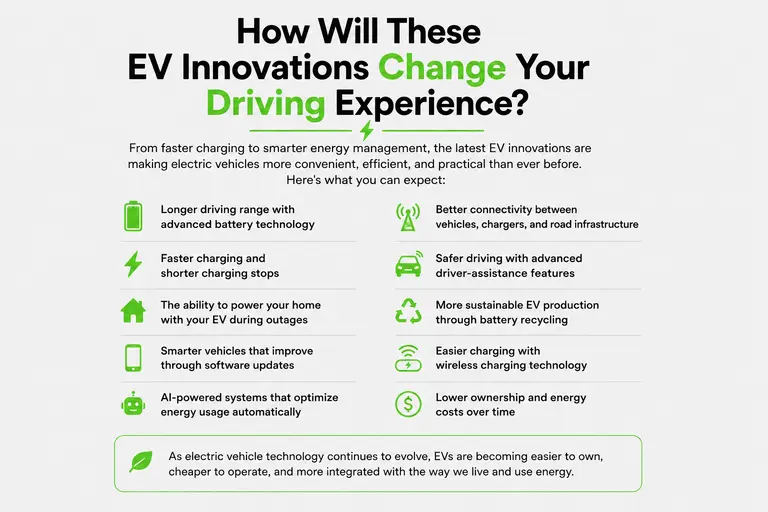
What do these electric vehicle innovations mean for you?
If you’re an EV owner, all of this is very encouraging.
You see, most of these EV innovations are focused on solving the biggest challenges drivers have faced over the years. For instance:
- Better batteries mean more driving range
- Faster charging means less waiting
- Smarter software means a better ownership experience
- V2G technology can help lower energy costs
- Connected vehicles can improve convenience and safety
In short, EVs are becoming more practical, more capable, and easier to live with.
But these innovations also bring us to a new reality, charging your EV at home.
Many homeowners are already adding Level 2 chargers to their homes. And with higher charging speeds and increased electricity demand, managing power safely is a big challenge.
Thankfully, with load sharing devices like simpleSwitch, charging your EV at home is more convenient than ever.
A device like this uses spare capacity on your existing electrical panel to charge your EV safely. And in the process, you save up-to $10,000 on unnecessary electrical services upgrades.
That’s amazing, isn’t it?
No More $10k Electrical Panel Upgrade to Charge Your EV at Home
simpleSwitch lets you add a Level 2 EV charger to your home without an expensive electrical panel upgrade. Your EV charges safety without panel overload.
- 30-day risk-free returns
- NEMA-rated
- Works with your existing panel
To sum up
As you can see, the future of mobility is being shaped by far more than just electric motors.
From solid-state batteries and ultra-fast charging to AI-powered systems and bidirectional energy flow, today’s electric vehicle innovations are making EVs smarter, more efficient, and more connected than ever before.
And the best part?
Many of these technologies are already being introduced into modern vehicles, with even more advancements expected in the coming years.
For EV owners like you, this means a future with better range, faster charging, lower operating costs, and greater convenience.
Got more questions or want to future-proof your home EV charging setup?
You can get in touch with us!
At simpleSwitch, we help homeowners charge their EVs safely without the need for expensive electrical panel upgrades.
Our EV energy management systems are designed to intelligently balance electrical loads, allowing you to make the most of your existing panel capacity while supporting home EV charging.
The result?
Safer charging, better energy management, and a more future-ready home charging setup.
Our EVEMS solutions are UL-listed and proudly made in the USA.
FAQs about electric vehicle innovations
What are the latest electric vehicle innovations?
Some of the biggest electric vehicle innovations include solid-state batteries, ultra-fast charging, Vehicle-to-Grid (V2G) technology, wireless charging, AI-powered energy management, and connected vehicle systems. These technologies are helping make EVs more efficient, convenient, and capable.
What are the biggest advancements in electric vehicles today?
Battery technology and charging technology are currently among the biggest advancements in electric vehicles.
Improvements in software, artificial intelligence, and vehicle connectivity are also playing a major role in enhancing the EV ownership experience.
How is AI being used in electric vehicles?
AI helps electric vehicles optimize energy consumption, improve battery performance, analyze driving behavior, and support advanced driver-assistance features. It can also help drivers make smarter charging decisions.
What is vehicle-to-grid (V2G) technology?
Vehicle-to-grid technology allows an EV to send electricity back to the power grid when needed. This can help support grid stability, improve energy management, and potentially reduce electricity costs for EV owners.
Will EV charging continue to get faster?
Yes. Charging technology is improving rapidly, with many newer charging stations capable of delivering significantly higher charging speeds. Future charging systems are expected to reduce charging times even further.
Why is home energy management important for EV owners?
As EV charging demand increases, managing household electricity usage becomes more important.
Energy management systems help prevent electrical overload, improve charging efficiency, and allow homeowners to make better use of their existing electrical infrastructure.