If you own an EV, I am sure you’ve already heard about EV charging levels and that each level offers a certain charging speed.
For instance, you might know that Level 1 charging is the slowest, Level 2 is moderately faster, and DC charging is the fastest way to charge your EV.
But what do these levels mean for your everyday EV charging needs and how much can you expect to pay for charging at each level?
In this blog, I have explained all three levels of EV charging in detail. I have detailed how fast you can realistically expect to charge your EV at each level and what your charging cost is going to be like with today’s energy rates.
So, read on to find answers to all your questions.
Key takeaways
- Level 1 charging uses a 120V household outlet. It works for EV owners who don’t drive a lot everyday.
- Level 2 charging uses a 240V outlet and is faster. It is the most practical option for charging an EV at home.
- DC fast charging is the quickest way to charge an EV. It is used at public charging stations and costs more.
- The charging level decides how quickly your EV charges. But the total energy cost depends on how much electricity your vehicle uses.
What are the three EV charging levels?
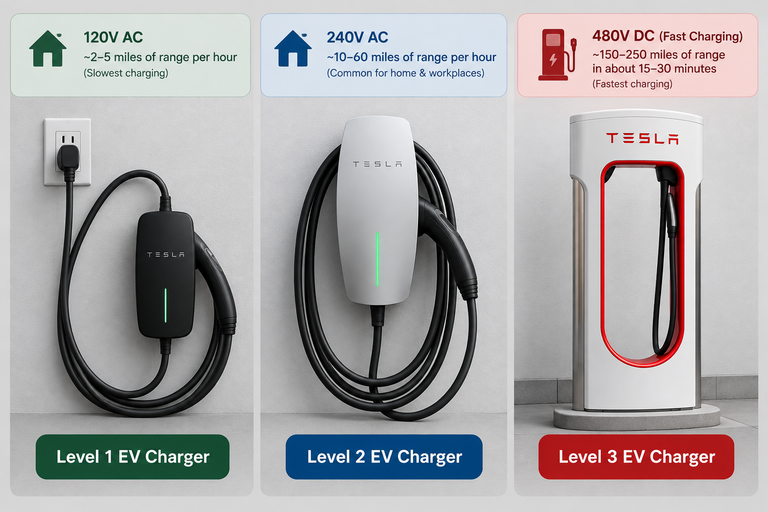
The three EV charging levels are Level 1, Level 2, and DC fast charging. The main difference between them is how much power they deliver to your EV and how quickly they can charge the EV battery.
For instance, Level 1 charging uses a standard 120V household outlet and it is the slowest option to charge EV. Here, you simply plug your EV into a regular outlet in your home.
Level 2 charging, on the other hand, uses a higher 240V AC supply and it charges your EV a lot faster.
Then there is DC fast charging which uses direct current to charge the EV battery. It charges your EV very quickly, well under 30 minutes.

No More $10k Electrical Panel Upgrade to Charge Your EV at Home
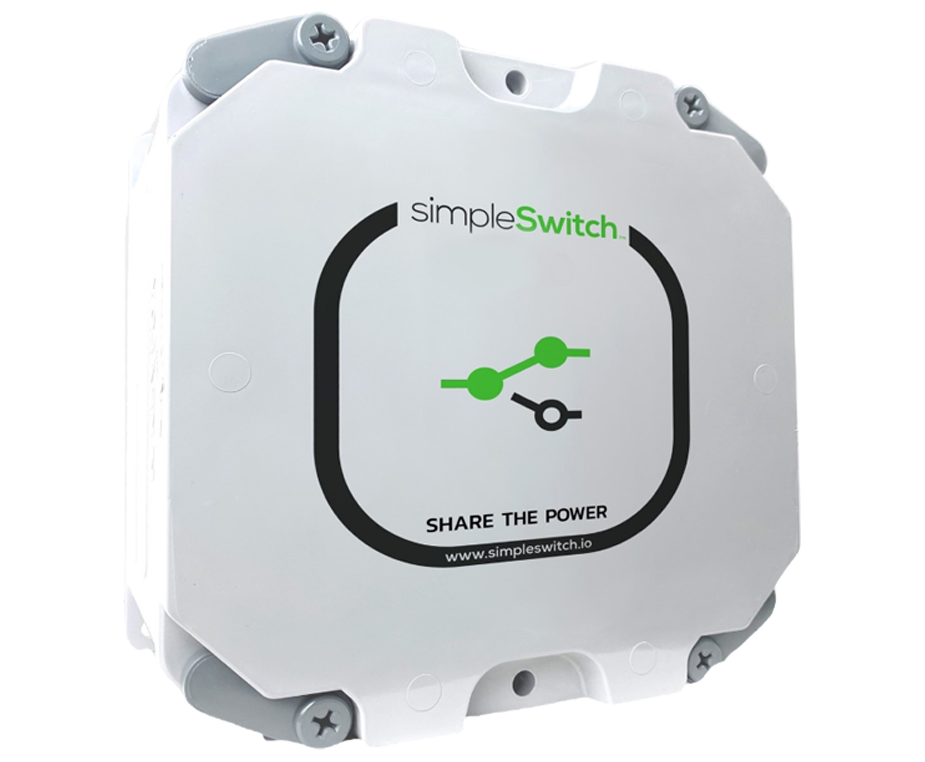
simpleSwitch lets you add a Level 2 EV charger to your home without an expensive electrical panel upgrade. Your EV charges safety without panel overload.
 30-day risk-free returns
- NEMA-rated
- Works with your existing panel
Here’s a quick look at the different EV charging types and their speed:
| Charging level | Power supply | Charging speed |
| Level 1 EV charging | 120V AC | About 2-5 miles of range per hour |
| Level 2 EV charging | 208-240V AC | About 10-30 miles of range per hour |
| DC fast charging | Direct current | Add about 100-200 miles of range in 30 minutes, depending on your EV and charger |
Now, let’s have a closer look at each level of EV charging.
A. Level 1 EV charging
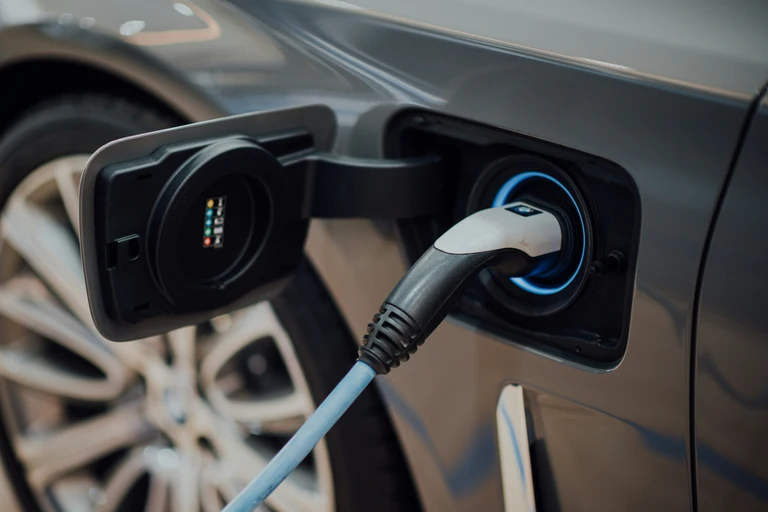
Level 1 charging offers the easiest way to charge your EV. Here, you don’t need any special charging setup at all. You can simply plug in your EV into any 120V household outlet, like the one you use to charge your phone or laptop.
The only trade-off is that this charging level is too slow for the everyday EV driver. It adds about 2-5 miles of range per hour. This means if you have a very low EV battery, it can take days until your car charges fully.
Yes, this is painfully slow for people who drive an EV everyday to work or to run errands. But if you drive very short distances, Level 1 charging can still work.
Here’s how the Level 1 math works: If you drive 30-40 miles a day and you charge your EV for about 10 hours, a Level 1 should be able to restore a lot of range.
How much does Level 1 charging cost?
The cost to charge EV at home using a Level 1 charger will be the same as Level 2 charger. That’s because notwithstanding whether you use a Level 1 or Level 2, the total energy flowing into your EV battery will be the same.
So, at the national average electricity cost of $0.18 per kWh and with an average 65 kWh battery, you can expect to pay about $11.96 in energy costs to charge your EV.
When does Level 1 charging make sense?
It makes sense to stick to a Level 1 charger if:
- You drive very few miles per day.
- Your EV stays parked at home for several hours.
- You already have access to a 120V outlet where you park.
- You are not in a hurry to charge your EV.
B. Level 2 EV charging
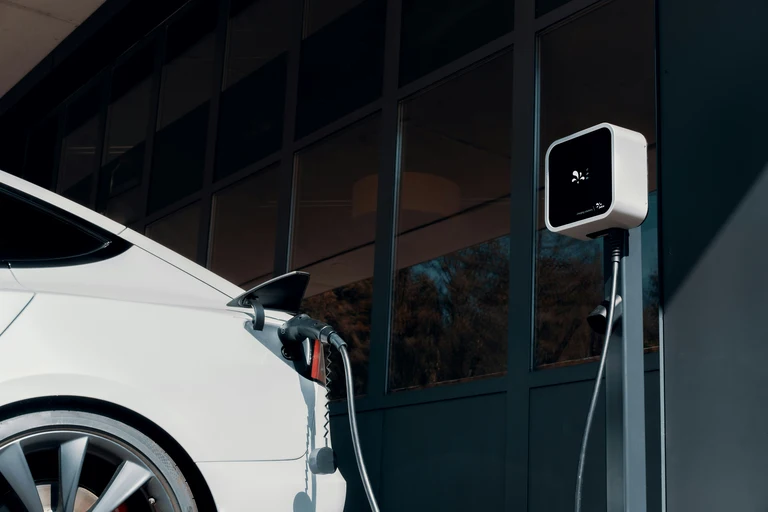
You will agree when I say that Level 1 charging can feel like the most painful experiences of all EV charging levels. That’s because most people don’t have the time and patience to wait for days to have their EV fully charged from zero to hundred.
A Level 2 EV charger solves exactly this problem. It uses a 208-240V AC supply instead of the 120V outlet used by Level 1 chargers. And depending on your EV and charger type, this can add about 10-30 miles of range per hour and fully charge the vehicle in 4-10 hours.
Practically speaking, if your EV battery range is near zero at night and you plug it in, you can be sure to have a fully charged battery by morning.
How much does Level 2 charging cost?
The cost to charge EV at home using a Level 2 charger is the same as a Level 1 charger. That’s because even at a faster charging speed, the amount of energy flowing into your EV is the same.
So again, you are looking at the same cost of $11.96 per full charge at home. This is with the average energy cost of $0.18 per kWh and a standard EV battery size of 65 kWh.
What about Level 2 charger installation?
Now, although the cost of EV charging is same for both Level 1 and Level 2 chargers, the cost of installation is an extra for the latter.
That’s because while you get a standard Level 1 charger along with your EV at no extra cost, the best home Level 2 EV chargers do cost between $300-$900. Also, you can expect to pay $100-$300 extra for installation labor.
And if your home’s electrical panel is already operating at full capacity, you might need to expand its capacity, which can be another $1500-$4500.
C. DC fast charging
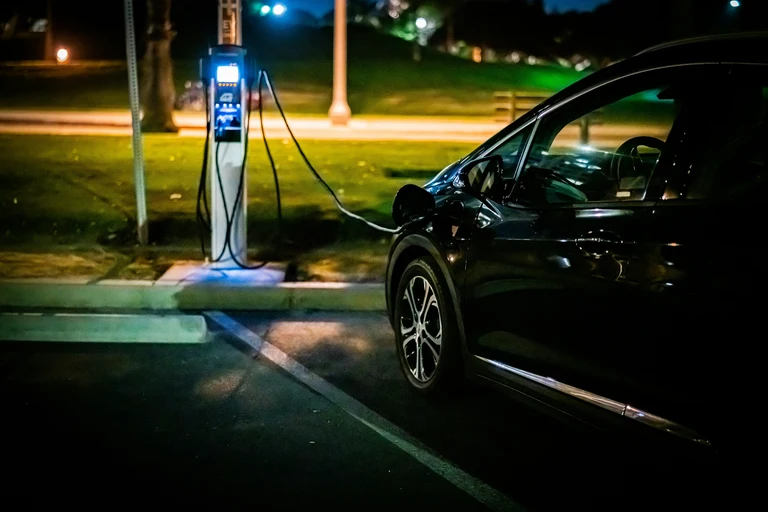
DC fast charging is designed for speed and convenience while you are on the move and can’t wait for hours to top-up EV battery.
You see, Level 1 and Level 2 charging supplies AC power to your EV. And your car’s onboard charger then converts it into DC.
However, DC fast charging supplies DC power directly to your EV battery, providing much higher charging power and a lot faster charging. So much so that you can expect a fast charger to add 100-200 (or even more) miles of range to your EV in just 30 minutes or less.
You will find DC fast chargers at public charging stations, mostly along highways and other places where drivers need to charge quickly.
How much does DC fast charging cost?
The cost to charge an EV at a public charging station can be double that of charging at home. That’s because the per kWh cost of charging at these charging stations is between $0.40-$0.60. For a standard 65 kWh EV battery, this translates to $26 to $39 for a full charge.
Pro tip: Look at DC fast charging as a tool for when you need it, not as your everyday charging method. If you’re driving long distances, it can save a lot of time. But if the car sits at home overnight, there’s no reason to pay for fast public charging when you can charge at home.
No More $10k Electrical Panel Upgrade to Charge Your EV at Home
simpleSwitch lets you add a Level 2 EV charger to your home without an expensive electrical panel upgrade. Your EV charges safety without panel overload.
- 30-day risk-free returns
- NEMA-rated
- Works with your existing panel
Here’s a quick look at the cost of charging EV at different levels of EV charging:
| Charging level | Typical speed | Common location | Cost per kWh |
| Level 1 | 2-5 miles/hour | Home | $0.12-$0.33 |
| Level 2 | 10-20 miles/hour | Home, work, public | $0.12-$0.33 at home and $0.25-$0.40 at public charger |
| DC fast charging | 180-240 miles/hour* | Public stations | $0.40-$0.60+ |
Which EV charging level is right for you?
Well, that depends on your daily driving habits, parking situation, and how quickly you need to recharge.
Here’s how I suggest you choose the right level of EV charging:
- Choose Level 1 if you drive very few miles per day and your EV sits in the parking overnight for several hours.
- Choose Level 2 if you drive more regularly and want to fully charge your battery conveniently while parked at home.
- Use DC fast charging when you are traveling or simply need a lot of range in a short time.
Conclusion
I am sure that you now have a good understanding of all the three EV charging levels.
As you can see, Level 1 charging is simple but it works only for drivers with lower daily mileage. Level 2 charging, at the same time, offers the most convenient way to charge EV at home.
DC fast charging is the fastest of all, but it is useful mostly when you need to recharge on the go when on a road trip.
Got more questions or want to charge your EV at home without upgrading your electrical panel?
You can get in touch with us!
At simpleSwitch, our EV energy management devices help you do exactly that, using spare power from other high-power appliances in your home. Our EVEMS devices are all UL-listed and proudly made in the USA.
FAQs about EV charging level
What are the three levels of EV charging?
The three EV charging levels are Level 1, Level 2, and DC fast charging.
Level 1 uses a standard 120V outlet, while Level 2 uses 208-240V AC and charges much faster.
DC fast charging supplies DC power directly to the EV battery and is designed for quick charging at public charging stations.
What’s cheaper, Level 1 or Level 2 charging?
Both cost the same when you are charging your EV at home because the total energy supplied to your EV is the same.
However, Level 2 charger comes with extra equipment and installation cost.
How much does it cost to charge an EV at a DC fast charger?
You can expect to pay between $26 and $39 for a full charge using a DC fast charger. The exact cost will depend on the fast charging network (like Tesla Supercharger Network or Electrify America), location, pricing structure, and time of use.
Can I install a Level 2 charger without upgrading my electrical panel?
Yes, you can.
Even if your home’s electrical panel capacity has reached its capacity, you can still install a Level 2 charger.
You need not upgrade your electrical panel. You can use a load sharing device like simpleSwitch to share the spare electrical power from other high-power appliances like dryer, induction cooktop, etc.