Thinking about getting an EV?
Awesome!
But if you’re new to EVs, there’s one thing that might be a little confusing, and that’s the kind of outlet you need to charge your car.
You’ll hear terms like Level 1, Level 2, J1772, NEMA 14-50, and CCS. And suddenly it will feel like you need a complete course about how to plug in your car.
However, it is not as overwhelming as it sounds once you get the basics.
In this blog, I am going to make it super simple for you.
I will walk you through the different types of EV charging outlet types. You’ll know which outlets are the most common for home use, what’s fast, slow, or somewhere in between.
So, let’s get started.
Key takeaways
- Level 1 EV charging uses a regular 120V outlet but charges slowly.
- Level 2 EV charging uses a 240V outlet and charges much faster.
- NEMA 14-50 is the most popular 240V outlet for EV charging.
- You can charge your EV at home without a special outlet, but it will be slow.
- Hardwired chargers offer a permanent, fast solution but require professional installation.
First, let’s clear the confusion between EV charging outlet and connector
When it comes to charging your electric vehicle, there are actually two parts you need to understand, the outlet and the connector.
- The outlet is the power source on your wall, the thing you plug your charger into.
- The connector is the plug that goes into your car to charge it.
A lot of people mix these up at first, and that’s totally okay. It can get a bit tricky because both are important for charging your EV, but serve different roles.
In this blog, I am mainly going to focus on the outlet types.
I will also touch on the connectors a little bit so everything clicks into place.
Sounds good?
Let’s dive in.

No More $10k Electrical Panel Upgrade to Charge Your EV at Home
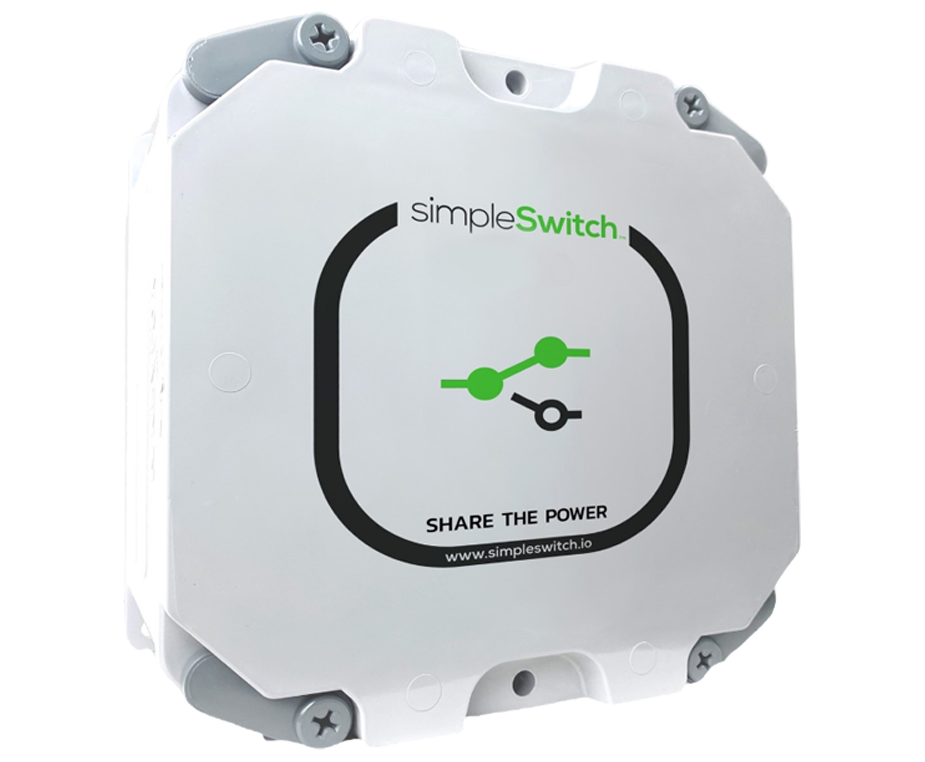
simpleSwitch lets you add a Level 2 EV charger to your home without an expensive electrical panel upgrade. Your EV charges safety without panel overload.
 30-day risk-free returns
- NEMA-rated
- Works with your existing panel
What are the different EV charging outlet types?
When it comes to charging your EV at home, there are a few different outlet types you can choose from, with each outlet offering different speeds and convenience levels.
For instance, the two most common EV outlet types are 120V outlets and 240V outlets.
Here, 120V outlets can power a basic Level 1 charger, but they charge your EV very slowly.
On the other hand, 240V outlets can power Level 2 EV chargers and make sure you charge your car much faster.
Also, within the 240V category, there are several different outlet types, such as the NEMA 14-50, NEMA 6-50, and NEMA 14-30.
Plus, some chargers don’t even use an outlet at all. Instead, they’re hardwired directly into your home’s electrical panel.
I have covered them all in detail in the below sections.
1. 120V outlet for car charger

A 120V outlet is the most common electrical outlet in your home, something you might already be using for charging your phone, plugging in a lamp, or powering your TV. And it is used by Level 1 EV chargers.
Here, you can simply plug your EV into a regular outlet with 120V capacity, and there’s no special installation needed.
In fact, you’ll get a compatible Level 1 charging cable when you buy an electric car, so there’s no need to buy it separately.
How fast is a 120V electric car outlet?
Charging out of a 120V electric car outlet is really slow. You’re looking at only 2-5 miles of range per hour of charging.
So, if you plug your car in overnight, you might add about 20-50 miles of range by the time you wake up.
That’s fine if you don’t drive a lot, but it can feel like a snail’s pace if you’re using your EV for daily driving.
Who is 120V outlet charging good for?
A 120V EV car charging outlet is good if:
- You drive a plug-in hybrid (a car that uses both gas and electric power).
- You don’t drive far every day, maybe just short trips or errands.
- You’re a renter who can’t install a new outlet.
- You just need backup or emergency charging when you’re in a pinch.
What are the downsides of this outlet for EV charging?
While Level 1 is super convenient, it’s too slow for most full EVs if you drive regularly. It struggles to keep up with daily use, especially if you need your car charged quickly.
Also, cold weather can slow down the charging process even more, making it less reliable during winter months.
In the long run, this isn’t ideal for most EV owners who want faster charging.
2. 240V outlet for car charger

A 240V outlet is something Level 2 EV chargers use. This is the same type of outlet you use for appliances like your electric dryer, oven, or water heater.
The outlet can deliver a lot more power than a standard 120V outlet. And that’s exactly why Level 2 charging is much faster and most people choose it for their charging their electric vehicle at home.
What makes this electric car outlet fast?
The reason Level 2 charging is so much faster is simple: 240V outlets deliver more power.
With more electricity flowing, your EV can charge at a much higher rate and you’re not waiting around all day for a few extra miles.
Unlike 120V outlets, which only give you a slow trickle of power, 240V outlets give your car a boost that it needs for daily use.
Whether it’s an overnight charge or a mid-day top-up, 240V outlets, along with the right Level 2 charger, are much more reliable.
How fast is a 240V outlet for EV charging?
With a 20V outlet and Level 2 charger combination, you can expect to add 20 to 40 miles of range per hour of charging.
So, if you’re plugging your car in overnight, you’ll likely wake up to a full charge.
For most drivers, this is perfect because it means you don’t have to worry about constantly topping off your battery.
TL;DR, here’s how 120V vs 240V EV charging outlet types compare:
| Feature | 120V | 240V |
| Outlet Type | Regular household outlet | Dryer or oven outlet |
| Charging Speed | Slow (2-5 miles per hour) | Fast (20-40 miles per hour) |
| Ideal For | Short trips, plug-in hybrids, emergency charging | Daily use, full EV owners |
| Installation | No special installation needed | Requires professional setup |
What are the most common 240V EV charging outlet types?

There are a few important 240V EV outlet types you’ll find on the market when installing a Level 2 charging station at home.
Let’s me walk you through them:
1. NEMA 14-50 outlet
The NEMA 14-50 outlet is by far the most common and widely recommended outlet for home EV charging.
You’ll see this type of outlet used for heavy-duty appliances, like electric ranges and RV hookups.
It is considered the standard for home EV charging because it’s designed to handle higher power loads without issues. This makes it perfect for charging your car quickly and safely.
Why do EV owners love it?
- The NEMA 14-50 supports fast Level 2 charging speeds, so your EV can get a significant charge in a short amount of time.
- It is widely compatible with almost every EV charger out there, so no matter what kind of electric vehicle you drive, this outlet should work for you.
- If you decide to move or need to take your charger with you, the NEMA 14-50 is easy to unplug. It’s a great option if you want flexibility in the future.
In short, NEMA 14-5 outlets are the go-to choice for most EV owners looking for a quick, reliable charging solution at home.
2. NEMA 6-50 outlet
The NEMA 6-50 outlet is another type of 240V outlet, but it’s a bit less common for home use than the NEMA 14-50.
This outlet is typically used for welders and industrial equipment.
However, it works perfectly fine for Level 2 EV charging, and many people use it as an alternative to the 14-50.
If you already have a NEMA 6-50 outlet installed for something like a welder, you might be able to use it for your EV charger as well.
Why is it a good outlet for electric car charging?
- The NEMA 6-50 delivers strong power just like the 14-50, so it can charge your EV at Level 2 speeds.
- Some EV chargers are specifically designed to plug into this outlet, which can make the installation process easier.
- While it’s not as common for home use as the NEMA 14-50, it’s still a great option for people who already have one of these outlets or are building a new setup.
Just make sure that your EV charger is compatible with this outlet before you go this route, as it is not as universal as the 14-50.
3. NEMA 14-30 outlet aka dryer outlet
The NEMA 14-30 outlet is the same type of outlet used for dryers in your laundry room.
Many homeowners already have this outlet in their garage, which makes it an easy choice for some EV owners.
You can safely use this outlet for EV charging, but here are a few important things to know:
- The NEMA 14-30 doesn’t deliver as much power as the 14-50, so the charging speeds are slower.
- You’ll need to use a compatible charger or an adapter to make it work with your car’s charging port.
- Don’t run your dryer and EV charger at the same time on the same outlet. That could overload the circuit and cause problems.
While this outlet isn’t as fast as the 14-50, it’s a good temporary or budget-friendly solution if you’re not ready to install a dedicated 240V outlet. It can work if you drive short distances and don’t need rapid charging.
TL;DR, here are the most common 240V EV charging outlet types:
| Outlet Type | Description | Ideal For |
| NEMA 14-50 | Most common, widely compatible with all EVs, high-speed charging. | Most EV owners, flexible setup |
| NEMA 6-50 | Used for welders and industrial equipment, less common than 14-50. | Alternative for certain EV chargers |
| NEMA 14-30 | Common dryer outlet, slower charging speeds. | Budget-friendly or temporary solution |
Bonus: Hardwired chargers don’t need any outlet at all

Some Level 2 chargers don’t plug into an outlet at all. Instead, they’re hardwired directly into your home’s electrical panel.
This means that they’re permanently installed and can’t be easily moved to another location. And while it’s a bit more work to install, hardwired chargers have their benefits.
Here are both the pros and cons of hardwired chargers:
Pros:
- The setup looks clean and neat because there are no cords or plugs hanging around.
- These chargers can often offer slightly more power, so they can charge your EV even faster than a plug-in charger.
- Since it doesn’t plug into an outlet, there’s no wear and tear on the outlet over time.
Cons:
- Hardwired chargers are less flexible. If you move, you can’t take it with you, you’d need to have it reinstalled.
- Professional installation is required, so the cost is usually higher than for a plug-in charger.
If you don’t mind having a permanent setup and want the most efficient solution, a hardwired charger is a great option.
Here’s how hardwired chargers compare with plug-in chargers:
| Type | Description | Pros | Cons |
| Hardwired Charger | Directly wired into your electrical panel. | Faster charging, no outlet wear, clean setup | Permanent, higher installation cost |
| Plug-in Charger | Plugs into a standard 240V outlet. | Flexible, easier to install and move | Might wear out the outlet over time |
What are the different EV connectors that plug into these outlets?
When you’re charging your EV, you’ll also need to think about the connector, or the plug that goes into your car.
There are several types of connectors, but for home charging, you’ll mainly deal with these:
1. J1772 connectors
The J1772 connector is the standard connector for most non-Tesla EVs in the country.
This connector works with both Level 1 and Level 2 chargers. So whether you’re using a slow 120V outlet or a faster 240V outlet, you’ll be using the same type of connector.
If you drive a Nissan Leaf, Chevy Bolt, or any other non-Tesla EV, your car most likely uses the J1772 connector. It is a simple, reliable plug that’s easy to find at home charging stations and public chargers.
2. Tesla connector
Tesla uses a unique connector for their vehicles. But their cars also come with a special adapter that allows them to plug into J1772 chargers as well.
So, you can use pretty much any public charging station or home charger.
Tesla’s connector is designed for fast, efficient charging, and the company has made it easy for Tesla owners to charge anywhere.
3. CCS & CHAdeMO
The CCS and CHAdeMO connectors are used for DC fast charging, which is the ultra-fast charging you typically find at public charging stations.
These chargers can add significant range to your battery in a short time (sometimes in under 30 minutes!), but they’re not used for home charging.
TL;DR, here are the different EV connectors for the above outlets:
| Connector Type | Description | Compatible With | Used For | Charging Location |
| J1772 | Standard connector for most non-Tesla EVs in North America. | Most non-Tesla EVs (e.g., Nissan Leaf, Chevy Bolt) | Level 1 and Level 2 charging | Home charging, Public charging stations |
| Tesla Connector | Tesla’s unique connector, fast and efficient. | All Tesla vehicles | Level 1 and Level 2 charging | Home charging (with adapter), Public stations (with adapter) |
| CCS (Combined Charging System) | Fast charging system that supports both AC and DC charging. | Some EVs (mostly European and American models) | DC fast charging | Public DC fast charging stations |
| CHAdeMO | Fast charging system for older EVs. | Some EVs (mainly older models) | DC fast charging | Public DC fast charging stations |
Looking to buy an EV charger for home charging?
You can read my blog on the best home Level 2 EV chargers, where I’ve listed the best-rated budget-friendly chargers.
Do you need a panel upgrade to use a 240V outlet for EV charging?
For starters, most homes don’t need an electrical panel upgrade to use a 240V outlet for EV charging.
You can use simpleSwitch, an electrical load sharing device that makes sure your EV charger doesn’t overload your system.
How?
It helps balance the load between your EV charger and other high-power appliances like your oven or HVAC.
For instance, if you’re using your dryer, simpleSwitch will automatically pause your EV charging to make sure there’s enough power for the dryer. And as soon as the dryer shuts off, the charging kicks back on.
Sounds awesome, doesn’t it?
No More $10k Electrical Panel Upgrade to Charge Your EV at Home
simpleSwitch lets you add a Level 2 EV charger to your home without an expensive electrical panel upgrade. Your EV charges safety without panel overload.
- 30-day risk-free returns
- NEMA-rated
- Works with your existing panel
To sum up
I am sure that by now you know everything about EV charging outlet types, including the charging speed each outlet offers and how you can use them with your charger.
You can use both a 120V outlet and the different 240V outlets for EV charging.
However, if you want faster Level 2 charging, 240V outlets are the only way to go.
You need not upgrade your electrical panel though. You can use an automatic load management system like simpleSwitch to safely charge your EV and save thousands of dollars in service upgrade cost.
That’s amazing, isn’t it?
FAQs about EV charging outlet types
What’s the difference between a 120V and 240V outlet for EV charging?
A regular 120V household outlet is something you use for Level 1 charging. And it’s super simple, but it’s also pretty slow. You’ll add about 2-5 miles of range per hour of charging.
A 240V outlet (like the ones for your dryer or oven) is what you’ll use for Level 2 charging. Ad it’s much faster. You can expect 20-40 miles of range per hour, making it a much better option for regular EV owners who need faster charging.
Do I need a special outlet for Level 2 charging?
Yes, for Level 2 charging, you’ll need a 240V outlet.
Some common 240V outlet types are NEMA 14-50, NEMA 6-50, and NEMA 14-30.
These outlets provide the power necessary for faster charging.
Some Level 2 chargers are also hardwired directly into your electrical panel for a permanent, more powerful setup.
Can I use my regular household outlet for EV charging?
You can, but it’ll be slow.
Regular 120V outlets work for EV charging, but they only add about 2-5 miles of range per hour.
This might be fine for short trips or if you drive a plug-in hybrid, but it’s not ideal for a full electric car.
Do I need an electrical panel upgrade for Level 2 charging?
Not necessarily!
Most homes don’t need a full electrical panel upgrade to install a Level 2 charger. What matters is how much power your home is already using.
If you’re worried about overloading your system, a smart load management system like simpleSwitch can balance the power use between your EV charger and other appliances.
You might also want to read: How To Charge An Electric Car At Home?