EV charging often feels confusing to both new and old EV owners. And this is especially true for EV connectors.
After all, there are so many different types of connectors like J1772, CCS, CHAdeMO, and NACS.
In fact, every EV manufacturer seems to use a unique charging connector for their vehicles.
And although things are changing now, there won’t be a universal EV connector anytime soon.
The good part?
There aren’t dozens of plugs you need to memorize, and you don’t need to be techy to understand the different EV connector types.
In this blog, I will walk you through the different types of EV charging connectors. We will see both the most popular connectors and the ones you rarely see in the country.
So, let’s get started.
Key takeaways
- All EV charging is either AC (slow) or DC (fast)
- J1772 is the standard home charging plug for non-Tesla EVs
- NACS is Tesla’s connector and is becoming the U.S. standard
- CCS and CHAdeMO are mainly for public fast charging, not home use
- Most EV owners charge at home using Level 2 AC charging
- Adapters can help, as long as they’re manufacturer-approved
For starters, what is an EV connector?

An EV connector is just the plug that connects your electric car to a charging source.
That’s it. No complicated technology to understand.
Think of it like your phone’s charger.
Different phones use different charging cables. You plug in, power flows, and the battery charges.
Electric vehicles work the exact same way, it is just that they use bigger plugs.
But that said, you do need to know about different EV connectors because they affect a few very practical things in your day-to-day life. For instance, they determine:
- Whether a charger physically fits your car
- How fast your car can charge
- Where you can charge, like at home, at work, or on road trips
Once you know which connector your car uses, most of your charging decisions become easy.

No More $10k Electrical Panel Upgrade to Charge Your EV at Home
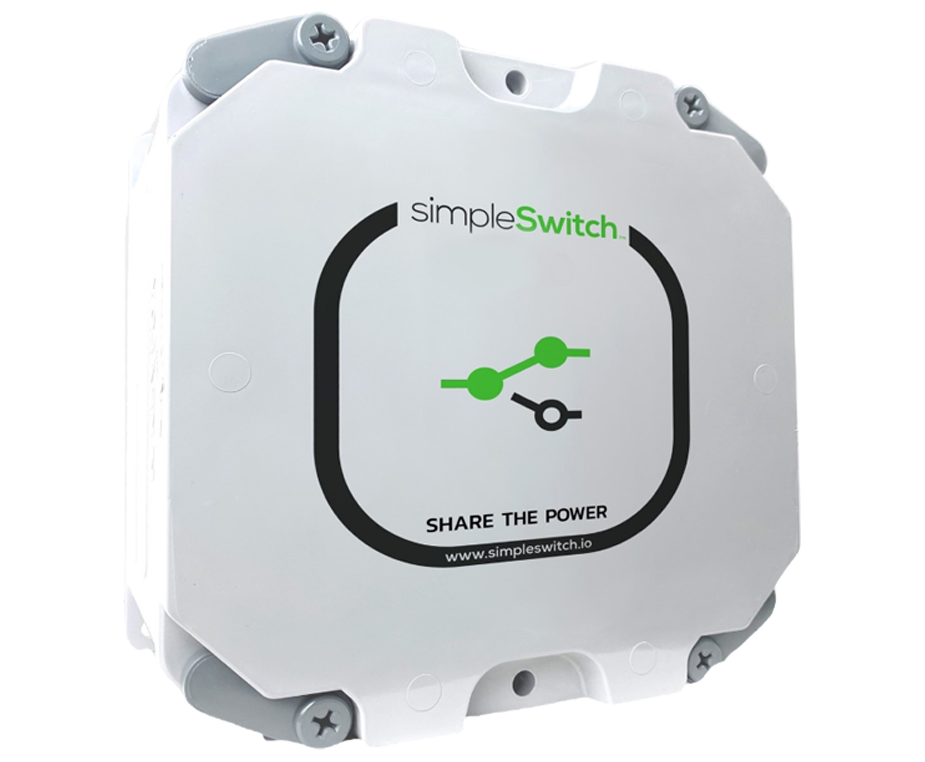
simpleSwitch lets you add a Level 2 EV charger to your home without an expensive electrical panel upgrade. Your EV charges safety without panel overload.
 30-day risk-free returns
- NEMA-rated
- Works with your existing panel
Important: All EV charger connector types are either AC or DC
Before we get into connector names like J1772 or CCS, there’s one simple thing you need to understand.
All EV charging falls into two categories: AC or DC.
Every connector, charger, and charging speed is built around one of these two types.
Here’s what these two charging categories are all about:
AC charging
AC charging is what most people use day to day. It’s found in home EV chargers (both 120V and 240V outlet chargers) as well as public charging stations that use a Level 2 EV charger.
DC charging
DC fast chargers are found at public fast-charging stations and they send power directly into the battery, skipping the car’s internal charger. This is why they’re much faster than AC chargers.
In short, here’s how AC and DC charging differ:
| Charging type | What it means |
| AC charging | Slower, used at home and most public chargers |
| DC charging | Much faster, used at public fast chargers |
| Key takeaway | Most connectors support both AC and AC charging |
What are the most common EV connector types?

Now let’s have a look at the actual electric vehicle charging plugs that you’ll use or you might already be using.
Don’t worry about memorizing everything here. The goal is just to recognize the main connector types and understand which ones matter for your car and your charging habits.
1. J1772 (type 1) connectors – The standard non-Tesla plug
If you drive a non-Tesla electric vehicle in the country, or elsewhere in North America, J1772 connectors are the ones you’ll see most often.
Think of it as the everyday charging plug. It is used for AC charging, which means slower but steady charging, perfect for home use or places where your car is parked for a while.
You’ll find J1772 plugs on almost all home Level 1 and Level 2 chargers.
Also, you might find them at public charging stations at malls, offices, parking garages, and apartment buildings.
Automakers like Ford, Chevrolet, Hyundai, Kia, Volkswagen, BMW, and Nissan all use J1772 for AC charging.
The biggest reason why J1772 connectors are so popular is that almost every non-Tesla EV supports it.
In fact, even Tesla owners can use this with an adapter.
In short, if you want to install a Level 2 home EV charger and don’t own a Tesla, this is usually the safest and most straightforward connector.
2. Tesla connector / NACS (North American charging standard)
Tesla’s charging plug, now officially called NACS or North American charging standard, is designed to do everything with one small, sleek connector.
And unlike other plugs that separate slow and fast charging, NACS handles both AC charging at home and DC fast charging on the road using the same port.
You’ll see NACS connectors on Tesla home chargers, Tesla Superchargers, and a growing number of public charging stations.
In fact, all Tesla models use this connector. This is also a big reason why Tesla charging has always felt simple to many drivers.
What has changed recently is that other automakers are adopting NACS too. For instance, brands like Ford, GM, Rivian, Volvo, Mercedes, and Hyundai/Kia have announced plans to switch their connectors to NACS. And that’s a big deal.
Why does it matter to you?
Well, NACS is quickly becoming the future standard. And if you’re thinking long-term, this connector offers excellent compatibility and access to one of the best fast-charging networks available.
3. CCS (combined charging system)
CCS is a connector mainly used for DC fast charging, especially on longer trips.
It looks a little unusual because it’s basically a J1772 plug with two extra pins added at the bottom. These extra pins are what allow much higher power to flow into the battery.
You’ll mostly see CCS at public fast-charging stations, and not at homes.
For many years, CCS has been the standard fast-charging option for non-Tesla EVs from brands like Volkswagen, BMW, Ford, GM, Hyundai, and Kia.
Here’s the important thing to know: CCS is still very common and very usable today. And you won’t suddenly lose access to public chargers if your car uses CCS.
Even though automakers are now shifting toward NACS, CCS won’t disappear overnight. But it might become less dominant over time.
4. CHAdeMO connectors (mostly being phased out)
CHAdeMO is one of the older DC fast-charging connectors, and you’ll mostly see it on earlier electric vehicles.
In North America, it’s best known for being used on older Nissan Leaf models and a few other early Japanese EVs.
Now, if your car uses CHAdeMO, you can still charge. But you’ll need to plan a bit more.
CHAdeMO chargers are becoming less common, especially as new charging stations focus on CCS and NACS instead. Moreover, most new EVs no longer support CHAdeMO at all.
This doesn’t mean CHAdeMO suddenly stops working. It just means the ecosystem around it is shrinking.
5. Type 2 (Mennekes) connectors – Common mostly in Europe
Type 2 connectors, also known as Mennekes, is the standard AC charging connector in Europe and parts of Asia. It serves the same basic purpose as J1772 but uses a different plug shape and electrical standard.
You generally don’t need to worry about Type 2 at all in North America. You won’t see it on home chargers or public stations in the country unless you’ve imported an electric vehicle from Europe.
6. CCS2 and GB/T connectors (used outside North America)
CCS2 and GB/T are charging standards used outside North America. CCS2 is the DC fast-charging standard in Europe, while GB/T is the system used in China.
For most EV owners in the country, these connectors won’t affect daily charging decisions at all. You won’t see them on any home chargers or public stations unless you’ve got an imported vehicle.
In short, here are all the different EV connector types:
| Connector | Where it’s used | Type of charging | Notes |
| J1772 | North America, most non-Tesla EVs | AC (home & public) | Standard for almost all non-Tesla EVs; Tesla can use with adapter |
| NACS (Tesla) | Tesla vehicles, growing adoption by other brands | AC & DC | Handles both home and fast charging; becoming future North American standard |
| CCS | Public fast chargers, mostly non-Tesla | DC | Extra pins allow higher power; common on long trips; slowly being replaced by NACS |
| CHAdeMO | Older EVs, mostly Nissan Leaf | DC | Legacy connector; fewer chargers available; mostly phased out |
| Type 2 (Mennekes) | Europe & parts of Asia | AC | European AC standard; uncommon in North America unless imported |
| CCS2 | Europe | DC | European fast-charging standard; not used in North America |
| GB/T | China | AC & DC | Chinese standard; irrelevant for most North American drivers |
What are the different EV connector types based on charging speed?

When it comes to EV charging, speed matters more than connector names.
The good thing is that charging speed falls into three simple levels, and each level uses specific connector types.
Let’s have a look at what types of EV charging connectors are used at different charging levels.
A. Level 1 charging uses J1772 or NACS connectors
Level 1 charging is the slowest way to charge an EV. It uses a standard 120-volt household outlet.
Here, you simply plug your EV into a regular outlet.
Both J1772 and NACS connectors support Level 1 charging.
B. Level 2 charging uses J1772 or NACS connectors too
Level 2 charging is the most common and practical option for everyday EV owners. It uses a 240-volt outlet and works with both J1772 and NACS connectors.
This setup typically adds 20 to 40 miles of range per hour, which makes overnight charging easy and stress-free.
C. DC fast charging uses CCS, NACS, or CHAdeMO connectors
DC fast charging is all about speed. These chargers use CCS, NACS, or CHAdeMO connectors and are found at public fast-charging stations.
They can charge an EV to about 80% in 20-40 minutes, which is why they’re mainly used on public charging stations and not at home.
In short, here are the EV connector types based on charging speed:
| Charging level | Typical connector | Speed |
| Level 1 (120V) | J1772 / NACS | Very slow |
| Level 2 (240V) | J1772 / NACS | 20-40 miles/hour |
| DC Fast Charging | CCS / NACS / CHAdeMO | 80% in 20-40 mins |
Which connector do you need for home charging?

If you drive a Tesla, you’ll want a home charger with the NACS (or Tesla) connector. It is designed specifically for Tesla vehicles but more manufacturers are adopting it now.
If you drive a non-Tesla EV, you can go for a J1772 connector. It is the standard for AC charging in North America and works with nearly every non-Tesla electric car on the road.
That’s really it.
You don’t need to think about CCS or CHAdeMO for home charging. These connectors are used for DC fast charging at public stations, not for residential setups.
Can you use adapters between EV connectors?

Yes, and this is more common than you might think.
Many EV owners use adapters to access more charging options.
For instance, Tesla drivers often use a J1772 adapter to charge at public AC stations. Tesla also offers approved adapters for CCS fast charging, which opens up even more public charging locations.
In some areas, CCS-to-Tesla support is also becoming available as charging networks evolve.
But it is important to use adapters safely. You should always use manufacturer-approved or certified adapters designed specifically for your vehicle.
Also, I suggest you avoid cheap, uncertified adapters, as they can cause charging issues or even damage your car.
No More $10k Electrical Panel Upgrade to Charge Your EV at Home
simpleSwitch lets you add a Level 2 EV charger to your home without an expensive electrical panel upgrade. Your EV charges safety without panel overload.
- 30-day risk-free returns
- NEMA-rated
- Works with your existing panel
Final words
By now, I am sure you know about all EV connector types and what kind of EV and charging set-up each supports.
You don’t need to know every plug type or charging standard to own an electric car.
Just remember the basics:
- J1772 is the standard for non-Tesla AC charging,
- NACS is Tesla’s connector and quickly becoming the North American standard
- CCS is mainly for public fast charging
- CHAdeMO is slowly being phased out
Want to install an EV charger at home but you’re stopped by electrical panel limitations?
You can get in touch with us!
At simpleSwitch, our award-winning made in the USA electrical load management systems are designed to solve exactly this problem. They let you safely power an EV charger by sharing power between other high-load appliances like dryer or induction cooktops.
The best part?
You save up-to $5000 in unnecessary electrical upgrades.
That’s amazing, isn’t it?
FAQs about EV connector types
Do all electric cars use the same charging connector?
No, not yet.
Different EVs use different connectors depending on the brand and where the car is sold.
In North America, most non-Tesla vehicles use J1772 for home charging, while Tesla uses NACS.
For fast charging, cars use CCS, NACS, or (less commonly) CHAdeMO.
What connector do I need for home charging?
For home charging, the answer is very simple.
If you drive a Tesla, you’ll want a charger with a NACS (Tesla) connector. And if you drive a non-Tesla EV, you’ll want a J1772 connector.
That’s it.
You don’t need CCS or CHAdeMO at home.
Can I use a Tesla charger with a non-Tesla EV?
Sometimes, yes, but it depends on the charger.
Non-Tesla EVs can’t plug directly into most Tesla home chargers or Superchargers without support or adapters.
However, more public chargers and automakers are moving toward NACS, which is making this easier.
Is DC fast charging bad for my EV battery?
A lot of EV owners wonder whether or not does fast charging affect EV battery life.
Now, DC fast charging isn’t bad in moderation, but it’s not meant for everyday use. These chargers send a lot of power into the battery very quickly, which creates more heat.
This is why most people use Level 2 charging at home for daily driving and save DC fast charging for road trips.
Occasional fast charging is completely fine, just don’t rely on it as your main charging method.
Do I need a special outlet to install a home ev charger?
Yes, for Level 2 home charging, you typically need a 240-volt outlet, similar to what a dryer or oven uses.
Will my EV connector still work in the future?
Yes. Even though charging standards are evolving, existing connectors aren’t suddenly becoming useless.
J1772 and CCS are still widely supported, and adapters help bridge gaps.
With many automakers moving to NACS, compatibility is actually improving. If you choose the right connector for your car today, you’ll be able to charge reliably for many years.