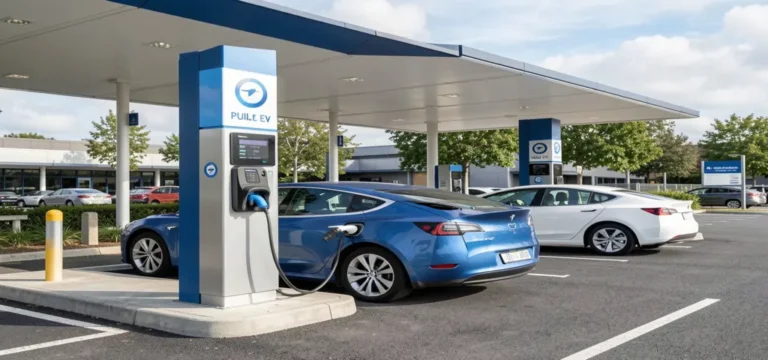
A NEMA 5-15 plug is the standard three-prong household plug that we have in homes across the country. In fact, this is one of the most common NEMA power connectors.
You might already use it everyday to charge your phone, plug in your TV, light a table lamp, or use any other regular household appliance.
And since this plug provides a 120-volt power, you can also use it to charge your EV at home.
Yes, charging EV from a regular outlet like this is much slower than using a standard Level 2 charger. But it can still charge your EV without any expensive upgrade or charging setup.
In this blog, I have explained exactly what is aNEMA 5-15 plug, how fast it can charge your EV, and if it makes sense to use it for EV charging.
So, let’s get started.
Key takeaways
- NEMA 5-15 is the standard 120-volt, 15-amp household outlet.
- It is used for Level 1 EV charging.
- You can charge an EV using a compatible NEMA 5-15 plug without installing a 240-volt outlet.
- Charging is much slower than Level 2 charging.
- Whether NEMA 5-15 is ideal for your EV charging needs depends on how much you drive and how long your EV stays plugged in.
What is a NEMA 5-15 plug?
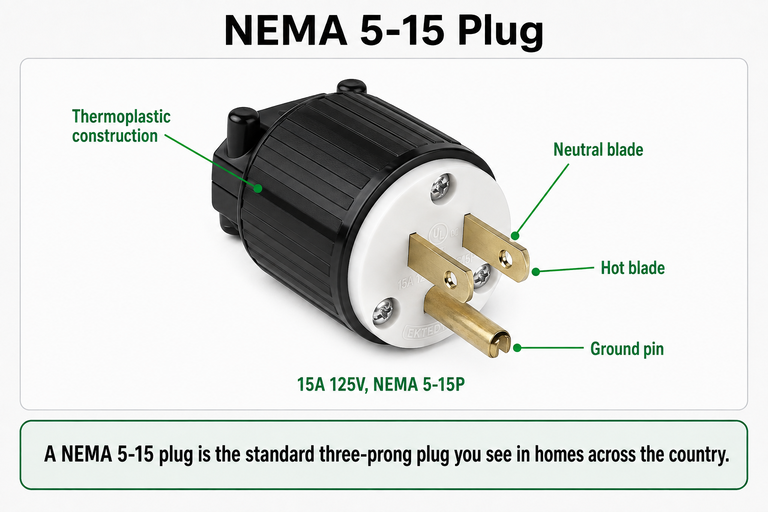
A NEMA 5-15 plug is the standard three-prong electrical plug you see in most homes.
NEMA stands for the National Electrical Manufacturers Association, which develops standards for electrical equipment and connectors. And the 5-15 part of the name tells you about the plug’s configuration and electrical rating.
The NEMA 5-15 is designed for a maximum of 15 amps and 125 volts. It has two flat blades for the hot and neutral connections, along with a grounding pin.
To put it simply, it is your regular household plug.
The plug is technically called a NEMA 5-15P, while the outlet or receptacle it plugs into is called a NEMA 5-15R.

No More $10k Electrical Panel Upgrade to Charge Your EV at Home
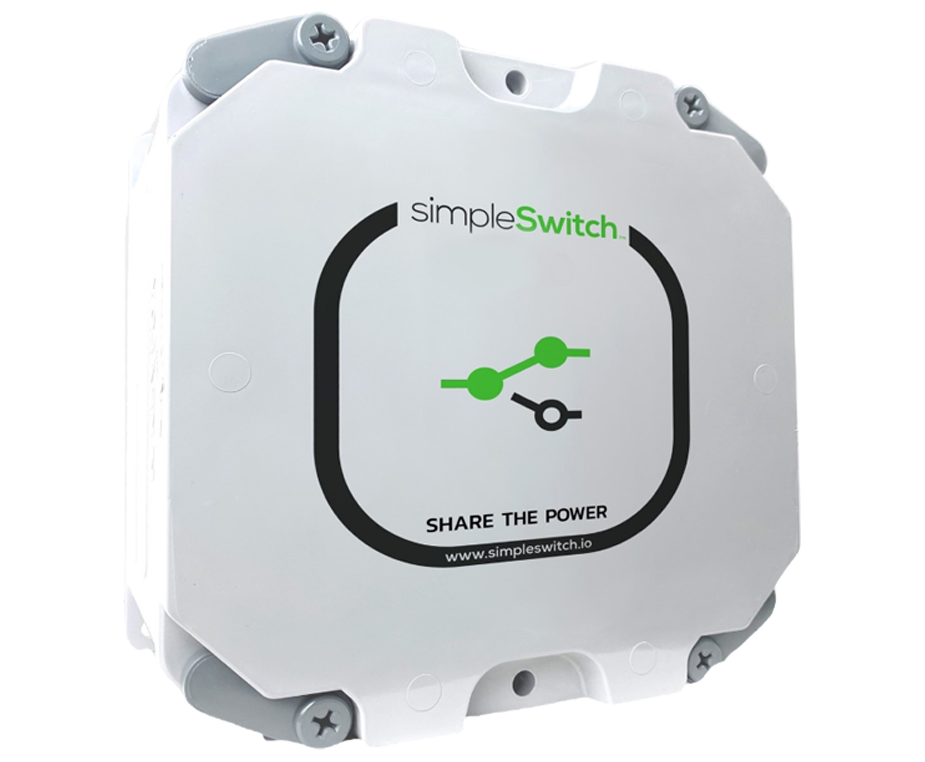
simpleSwitch lets you add a Level 2 EV charger to your home without an expensive electrical panel upgrade. Your EV charges safety without panel overload.
 30-day risk-free returns
- NEMA-rated
- Works with your existing panel
Why is the NEMA 5-15 outlet so common?
The NEMA 5-15 outlet is the simplest electrical outlet to use. Also, it is the standard household outlet in most homes nationwide.
So, unlike a NEMA 14-50 outlet, which you need to install specifically for a Level 2 EV charger, the NEMA 5-15 is already installed in your home.
You already use it for lamps, TVs, computers, kitchen appliances, and a lot of other everyday devices. And you can also use the same outlet to charge your EV.
Can you use a NEMA 5-15 plug for EV charging?
Yes, you can.
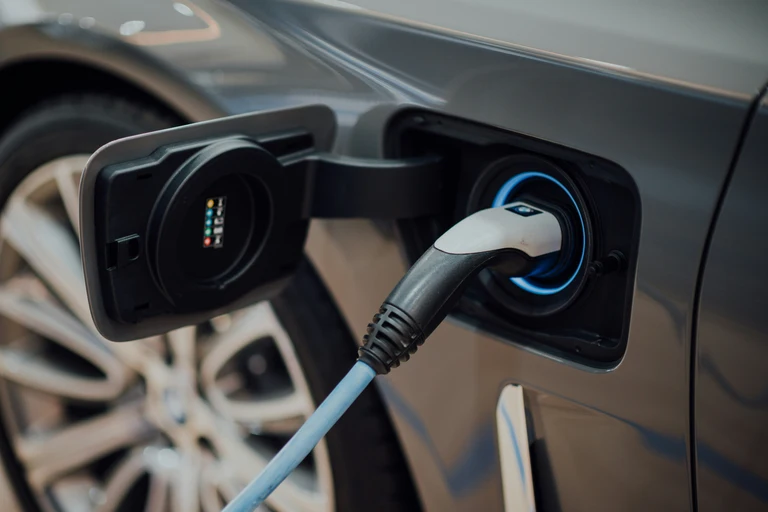
In fact, a NEMA 5-15 plug is one of the most common options for Level 1 EV charging.
A Level 1 EV charger plugs into a standard 120V outlet on one end and connects to your vehicle on the other. And as per the Department of Energy’s Alternative Fuels Data Center, NEMA 5-15 is the ideal standard household connector for Level 1 charging.
So, if your EV came with a portable Level 1 charging cable with a NEMA 5-15 connector, you can plug it into any standard household outlet and start charging. There is no need to install a dedicated 240V outlet just to charge your EV.
How does NEMA 5-15 EV charging work?
It is simple.
Your home’s electrical panel supplies 120V power to the NEMA 5-15 outlet. You plug your EV charger’s NEMA 5-15 plug into that outlet, and the charger delivers electricity to your vehicle. The EV’s onboard charger then converts that AC electricity into the DC electricity needed to charge the battery.
The only downside to this is slow EV charging time.
As per Department of Energy’s own estimates, Level 1 charging provides roughly 5 miles of driving range for every hour of charging. And although the actual charging speed depends on your EV, charging equipment, battery condition, and other factors, this is still very slow.
For instance, if you leave your EV plugged in for eight hours overnight, you could add around 40 miles of range.
Now, if you use your EV for regular daily errands like grocery shopping or commuting to work nearby, this is fine. But if you drive long distances everyday, this range might not be enough for you.
Is NEMA 5-15 ideal for EV charging?
Just because you can charge your EV from a NEMA 5-15 outlet doesn’t mean it is the best option for you.
Of-course, if you have a short daily commute, come home in the evening, and leave your EV plugged in overnight, a NEMA 5-15 charger will give you everything you need.
For instance, let’s say you drive only 20 to 30 miles a day. In this case, you can leave your EV plugged in for several hours and replace a good part of the range you used during the day.
But here’s the downside:
Level 1 charging is slow.
If you drive a lot every day or regularly come home with a nearly empty battery, a NEMA 5-15 charger will struggle to put back enough range overnight.
This is where you’ll need to install a Level 2 charger.
A Level 2 charger uses 240V power and a different NEMA plug type, such as NEMA 14-50 plug. And it can add range much faster than a standard 120V NEMA 5-15 setup.
NEMA 5-15 vs NEMA 14-50: Which is better for EV charging?
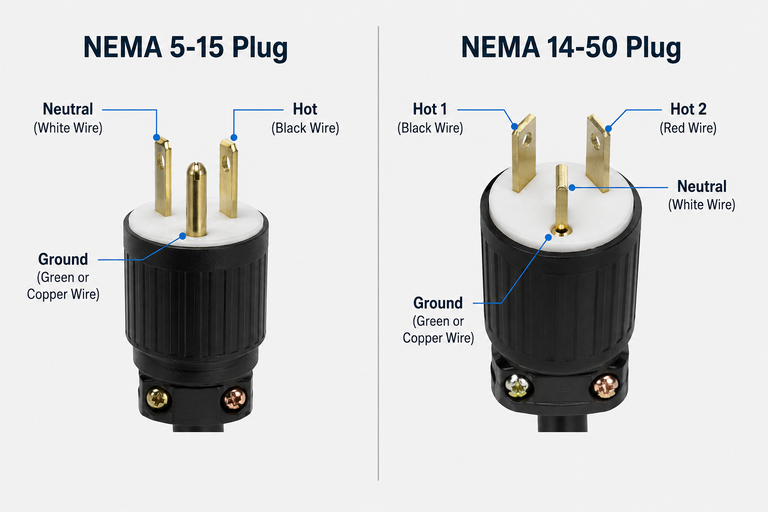
The right NEMA plug type for EV charging isn’t the same for everyone.
A NEMA 5-15 is easier to use because you probably already have the outlet.
A NEMA 14-50, on the other hand, helps you charge EV much faster using a Level 2 charging setup. However, it also requires a dedicated 240V circuit and proper installation.
Here’s how 5-15 and NEMA 14-50 compare for EV charging:
| NEMA outlet | Voltage | Charging level | Best for |
| NEMA 5-15 | 120V | Level 1 | Short daily driving & overnight charging |
| NEMA 14-50 | 240V | Level 2 | Faster home EV charging |
NEMA 5-15 vs NEMA 5-20: What’s the difference?
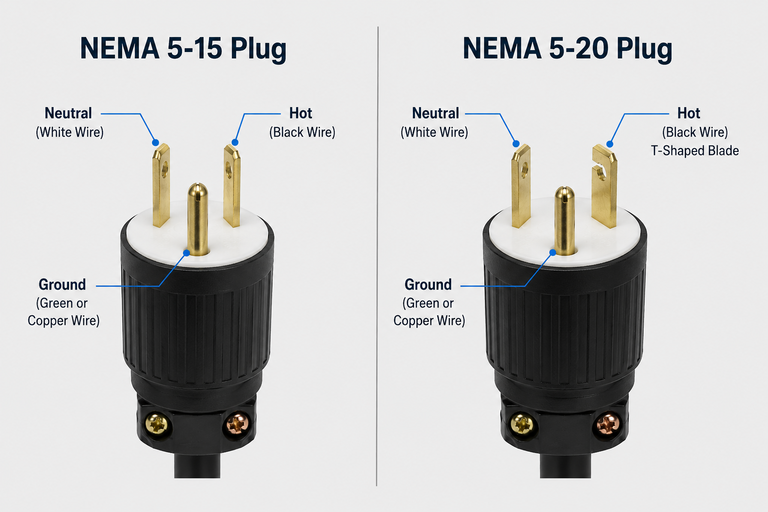
Both are 120V connectors, but the main difference is their current rating.
A NEMA 5-15 is rated for 15 amps, while a NEMA 5-20 is rated for 20 amps. The 5-20 receptacle also has a T-shaped slot that allows it to accept both NEMA 5-20P and NEMA 5-15P plugs.
So, can you plug a NEMA 5-15 into a NEMA 5-20?
Yes.
A NEMA 5-15P plug is designed to fit a compatible NEMA 5-20R receptacle. Nevertheless, the reverse isn’t true. Meaning a NEMA 5-20P plug won’t fit into a standard NEMA 5-15R outlet.
This is intentional.
The configuration prevents a higher-current 20-amp device from being plugged into a 15-amp receptacle that isn’t designed for it.
NEMA 5-15 plug vs NEMA 5-15 outlet: What’s the difference?
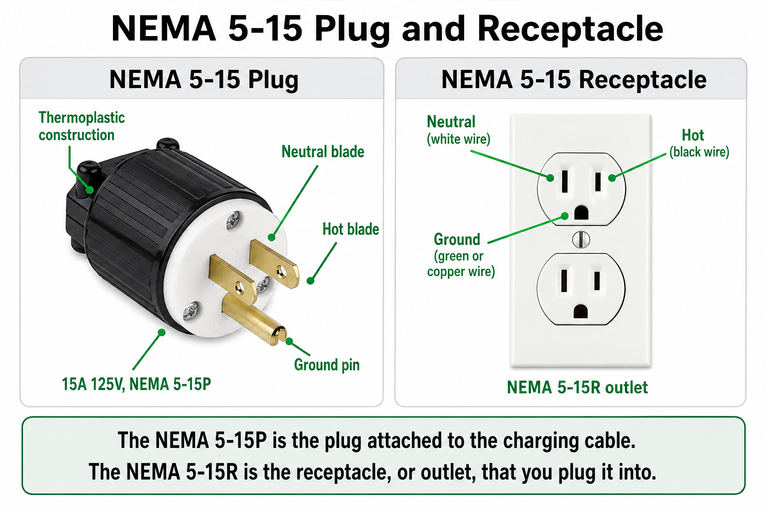
The difference between NEMA 5-15 plug and outlet is simple:
- The NEMA 5-15P is the plug attached to the charging cable.
- The NEMA 5-15R is the receptacle, or outlet, that you plug it into.
Technically, P means plug and R means receptacle.
Bonus: Here’s how to decide if a NEMA 5-15 plug is the right choice for EV charging
| Situation | NEMA 5-15 |
| You drive short distances every day | Good option |
| You charge overnight | Good option |
| You already have a suitable outlet | Good option |
| You want a simple charging setup | Good option |
| You have a long daily commute | Can be too slow |
| You need to add lots of range quickly | Not ideal |
Pro tip: Don’t assume that any household outlet is automatically suitable for continuous EV charging. Your outlet, wiring, circuit, and charging equipment should all be in good condition and properly rated for the intended use.
No More $10k Electrical Panel Upgrade to Charge Your EV at Home
simpleSwitch lets you add a Level 2 EV charger to your home without an expensive electrical panel upgrade. Your EV charges safety without panel overload.
- 30-day risk-free returns
- NEMA-rated
- Works with your existing panel
Wrapping it up
I am sure that you should have a much better understanding of the NEMA 5-15 plug and how it works for EV charging.
And as you can see, you don’t need a special outlet just to charge an EV. If you have a suitable NEMA 5-15 outlet at home, you can use a compatible Level 1 charger and charge your EV using regular 120V power.
However, if you need faster EV charging, you’ll need a NEMA 14-50 plug and an electrical panel with enough spare electrical capacity.
Now, if your electrical panel capacity is not sufficient, you need not upgrade the panel by spending tens of thousands of dollars. You can use a load sharing device like simpleSwitch to automatically share the spare power from other high-power appliances like dryer or induction cooktop.
At simpleSwitch, our load sharing devices are all UL-listed and proudly manufactured in the USA.
FAQs about NEMA 5-15 plugs
What is a NEMA 5-15 plug?
A NEMA 5-15 plug is the standard three-prong household plug used with 120V electrical outlets in the country. It is rated for up to 15 amps and is commonly used for household appliances and Level 1 EV charging.
Is NEMA 5-15 120V or 240V?
NEMA 5-15 is a 120V configuration, with a maximum rating of 15 amps. It is designed for standard household electrical circuits.
Can you charge an EV with a NEMA 5-15 outlet?
Yes. A compatible Level 1 EV charger can plug into a NEMA 5-15 outlet and charge your EV using 120V power.
How fast is NEMA 5-15 EV charging?
NEMA 5-15 is used for Level 1 charging, which is much slower than Level 2. Depending on the vehicle and charging equipment, you can expect only a few miles of driving range per hour of charging.
Can you plug a NEMA 5-15 into a NEMA 5-20?
Yes. A NEMA 5-15P plug can fit into a NEMA 5-20R receptacle. However, a NEMA 5-20P plug cannot fit into a standard NEMA 5-15R receptacle.
Is NEMA 5-15 good enough for EV charging?
It can be.
If you have a short commute and charge your EV overnight, Level 1 charging from a NEMA 5-15 outlet can be perfectly adequate.