Whether you’re planning to install a home EV charger or upgrade your existing charger, there’s a good chance you’ve come across NEMA connectors. You might have particularly seen names like NEMA 14-50, NEMA 14-30, or NEMA 6-50.
So what do these names mean and which NEMA plug is meant for your EV?
For starters, NEMA plugs are a type of electrical outlet your EV charger plugs into at home.
And these are different from EV connector types like J1772, NACS, and CCS that connect your charger to your car.
A good understanding of NEMA plug types can help you choose the right EV charger and avoid expensive charger installation mistakes.
In this blog, I have explained it all in detail, including different NEMA connector types, what the NEMA ratings mean, and which outlet is right for your home.
So, let’s get started.
Key takeaways
- NEMA plugs are the electrical plugs and outlets used to power home EV chargers.
- NEMA 14-50 is the most common outlet for Level 2 EV charging.
- NEMA 14-30 and NEMA 6-50 are also popular options for some EV chargers.
- The numbers in a NEMA plug indicate its configuration and amperage rating.
- The best outlet for your EV charger depends on your electrical panel, charger, and installation requirements.
What is a NEMA plug?
A NEMA plug is simply a standardized electrical plug and outlet used throughout the country.
NEMA stands for the National Electrical Manufacturers Association, the organization that created these standards to keep electrical plugs and outlets consistent across the country.
You see, your home has different outlets for different appliances, and these outlets look different.
For instance, a regular wall outlet for your phone charger looks different from the outlet used by an electric dryer or oven. That’s because each outlet is designed to safely deliver a specific voltage and amount of electrical current.
The same thing applies to EV chargers.
Most Level 2 chargers plug into a dedicated NEMA outlet, which is why you hear names like NEMA 14-50 or NEMA 6-50.

No More $10k Electrical Panel Upgrade to Charge Your EV at Home
simpleSwitch lets you add a Level 2 EV charger to your home without an expensive electrical panel upgrade. Your EV charges safety without panel overload.
 30-day risk-free returns
- NEMA-rated
- Works with your existing panel
Why are NEMA plugs so important for EV charging?
If you’re buying a Level 2 home charger, the type of outlet you have is just as important as the charger itself.
That’s because not every EV charger uses the same outlet. Even the best Level 2 EV charger models are designed to plug into different outlets like NEMA 14-50, NEMA 14-30, or NEMA 6-50.
And some chargers don’t plug into an outlet at all, they’re hardwired directly into your home’s electrical system.
The outlet type also affects things like:
- Whether your charger can plug into an existing outlet
- Whether you need a new 240-volt circuit
- How much power your charger can safely deliver
- Whether a plug-in or hardwired installation makes more sense
The good part?
You don’t need to memorize every NEMA connector available.
For EV charging, only a handful of NEMA plug types are used. And once you understand these, choosing the right home charging setup becomes much more straightforward.
How are NEMA plugs named?
At first, names like NEMA 14-50 or NEMA 6-50 can look confusing. But they’re quite simple once you know what the numbers mean.
Take NEMA 14-50 for instance. Here, the number 14 refers to the plug’s configuration, which includes things like the number of prongs and how they’re arranged. The number 50, at the same time, tells you the outlet is rated for 50 amps.
Similarly, a NEMA 14-30 outlet uses the same plug configuration but is rated for 30 amps instead.
That’s simple, isn’t it?
What are the most common NEMA plug types for EV charging?
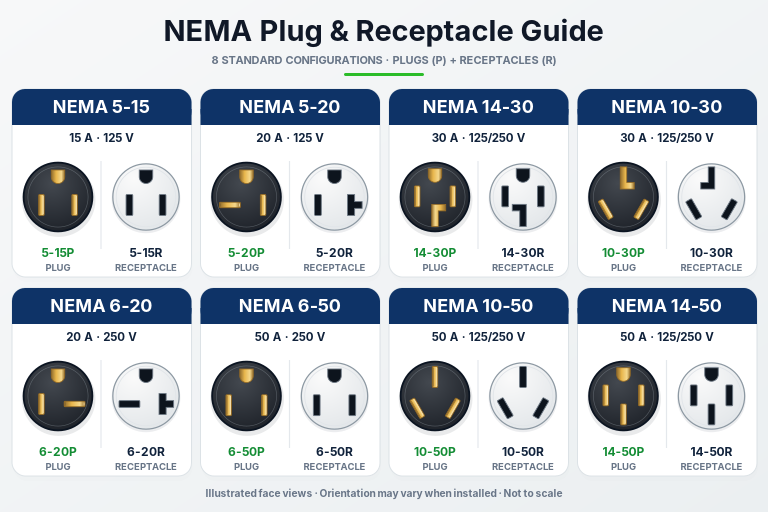
Now let’s look at the NEMA plug types you will most likely need to charge your EV at home.
You need not remember every detail. Simply understand which outlets are commonly used in homes and which one is ideal for your EV charger.
1. NEMA 5-15: The standard household outlet
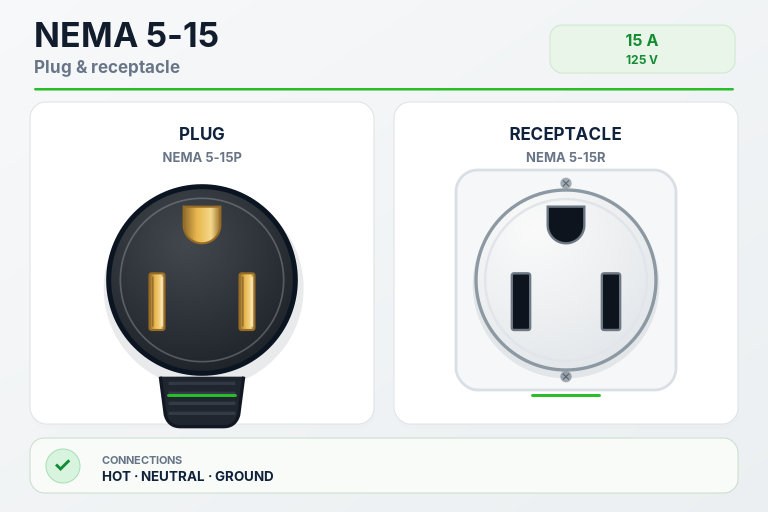
The NEMA 5-15 is the standard 120-volt outlet found in almost every home. It is the same outlet you use for lamps, TVs, and phone chargers.
This outlet supports Level 1 EV charging, which means you can charge your EV without installing any additional equipment.
The downside?
It is slow.
Most EVs get only about 3 to 5 miles of range per hour. So it makes sense only for those drivers who have short daily commutes or those who don’t mind leaving the car plugged in for an entire day.
How to identify a NEMA 5-15 outlet
Look for two vertical slots and a small, round or U-shaped grounding hole below them. This is the common household outlet found in most homes across the country, and I am sure you can find this in your home too.
2. NEMA 5-20: A slightly more powerful household outlet
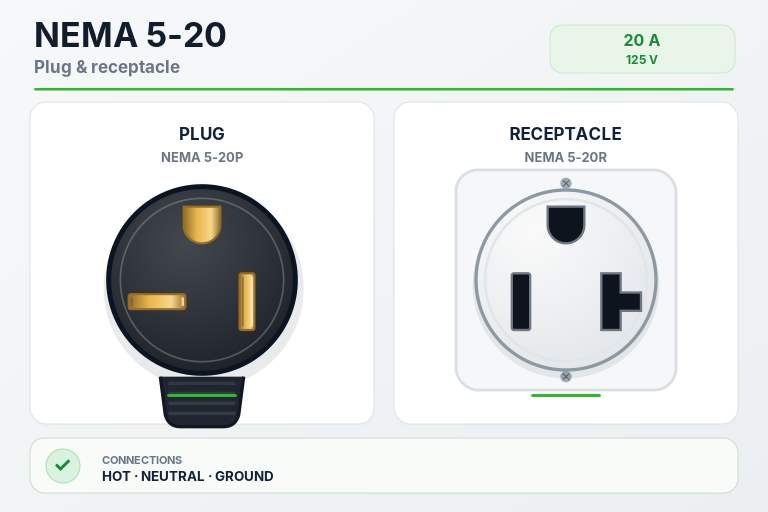
The NEMA 5-20 is a 120-volt, 20-amp outlet that looks similar to a standard household outlet but has a distinctive T-shaped slot.
It can support Level 1 EV charging at a higher current than a standard NEMA 5-15 outlet, provided the circuit and EV charging equipment support it. However, charging is still slow compared with standard 240-volt Level 2 charging.
How to identify a NEMA 5-20 outlet
Look for two vertical slots, with one slot shaped like a sideways T, and a grounding hole. The T-shaped slot is the easiest way to distinguish it from a standard household outlet.
3. NEMA 14-30: A practical option if you already have a dryer outlet
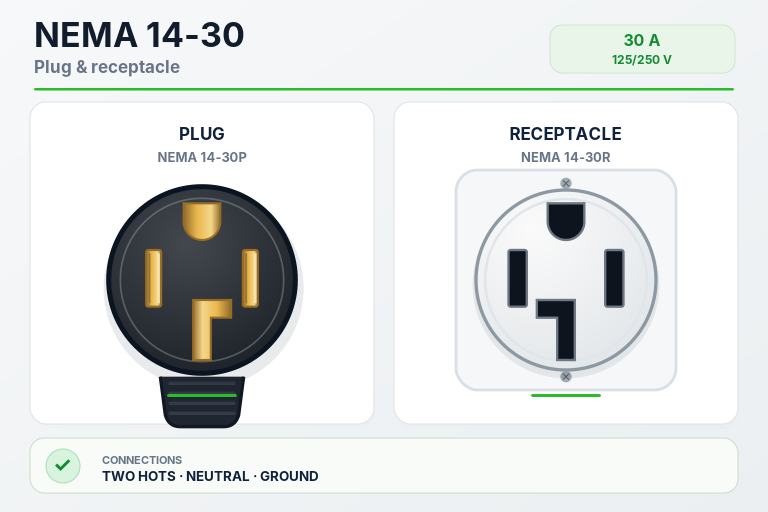
The NEMA 14-30 outlet, also called dryer outlet, is a 240-volt, 30-amp outlet that’s commonly used for electric clothes dryers.
If you already have this outlet installed in your garage or close to where you park, you can use it to charge EV with a compatible NEMA 14-30 EV charger.
Compared to a standard household outlet, it delivers much faster Level 2 charging. However, because it is rated for 30 amps, your EV charger will also be limited to a lower charging output than a 50-amp circuit.
For many drivers, though, that’s still more than enough for overnight charging.
How to identify a NEMA 14-30 outlet
Look for four openings, two angled slots, one L-shaped slot, and a grounding hole. This outlet is very common in homes with electric clothes dryers. If you use a dryer at home, this is the outlet your dryer likely uses.
4. NEMA 10-30: An older dryer outlet
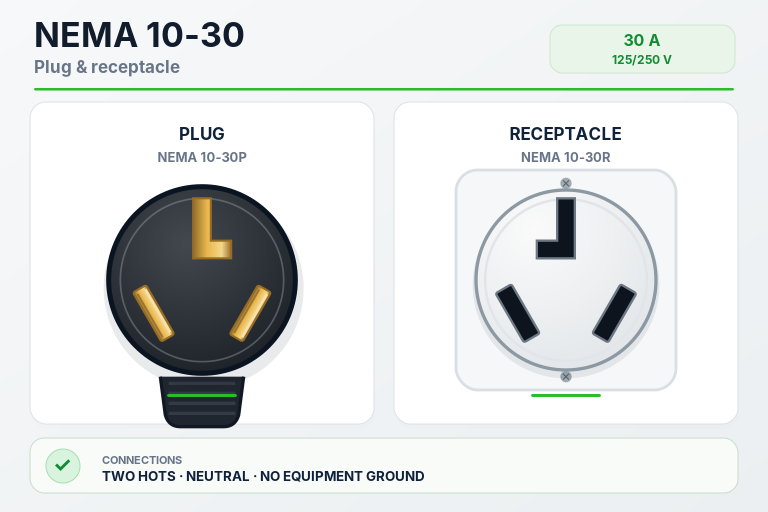
The NEMA 10-30 is an older, 240-volt, 30-amp outlet that you can find in homes with older electric dryer installations. It has three slots and does not provide a separate equipment-grounding conductor.
Although compatible EV charging equipment might be available, using this outlet for EV charging requires extra care because of its older wiring configuration. I suggest you have an electrician assess the installation and confirm that the proposed charging setup meets applicable electrical codes before using it.
How to identify a NEMA 10-30 outlet
Look for three openings, two angled blade slots and one L-shaped slot. This older dryer outlet has no separate grounding opening. And it doesn’t provide the same grounding protection as a modern four-prong outlet.
5. NEMA 6-20: Compact option for Level 2 charging
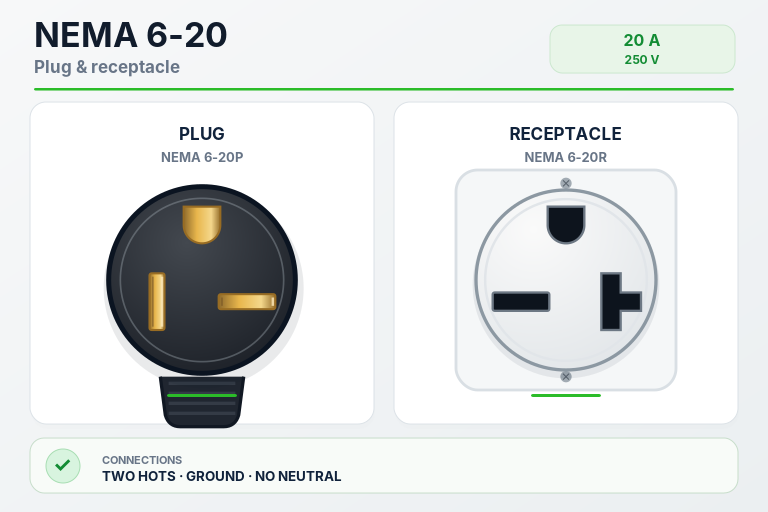
The NEMA 6-20 is a 240-volt, 20-amp outlet commonly found in workshops and some spaces with specialized electrical equipment. It can also be used with compatible portable EV chargers.
Since it supports a 240-volt supply, it offers faster charging than a standard 120-volt household outlet.
How to Identify a NEMA 6-20 Outlet
Look for two horizontal slots, with one slot turned sideways, and a U-shaped grounding hole. The outlet is mostly used for 240-volt equipment and is smaller than a NEMA 6-50 receptacle.
6. NEMA 6-50: Common outlet in garages and workshops
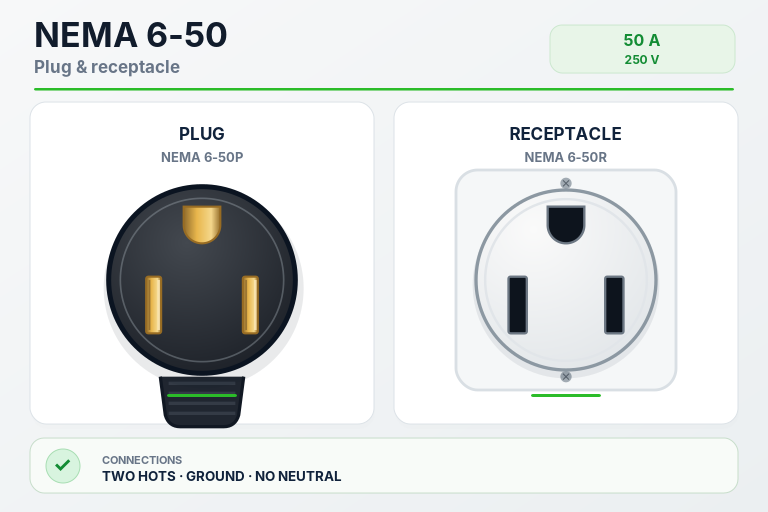
The NEMA 6-50 is another 240-volt outlet that’s found in garages and workshops, where it is commonly used for equipment like welders.
Today, many homeowners also use it with a NEMA 6-50 EV charger.
One thing that makes this outlet unique is that it doesn’t include a neutral wire. For most EV chargers, that isn’t a problem because they only need the two hot wires and a ground to operate.
If your home already has a NEMA 6-50 outlet, it can be a great option for Level 2 charging without installing a completely new circuit.
How to identify a NEMA 6-50 outlet
Look for two angled or straight blade slots and a grounding hole, usually in a larger, heavy-duty receptacle. Also, it has no neutral slot, which helps distinguish it from a NEMA 14-50 outlet.
7. NEMA 10-50: An older outlet for electric ranges
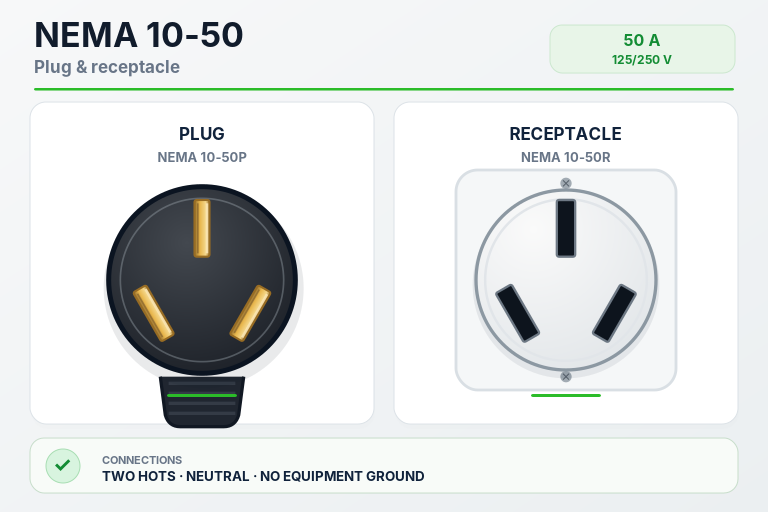
The NEMA 10-50 is an older, 125/250-volt, 50-amp outlet that was commonly used for electric ranges. It has three slots, making it different from the four-prong NEMA 14-50 outlet used in many modern EV charging installations.
Although its rating can look suitable for EV charging, don’t assume it can safely support a modern EV charger. It lacks a separate equipment-grounding conductor, so do have a qualified electrician assess the wiring and confirm code compliance before considering any charging setup.
How to identify a NEMA 10-50 outlet
Look for three openings arranged for two angled blade contacts and one L-shaped contact. It is an older range outlet design, and its appearance can resemble other three-prong receptacles, so do check the markings before identifying it.
8. NEMA 14-50: The most popular outlet for Level 2 EV charging
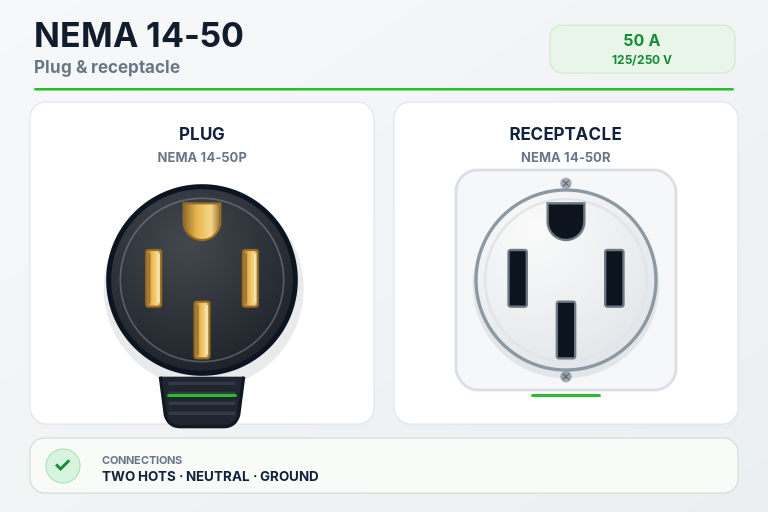
NEMA 14-50 outlet is the most commonly recommended outlet for plug-in EV chargers. This outlet provides 240 volts and is rated for 50 amps, giving most EV chargers plenty of power for fast overnight charging.
It is also the outlet you’ll find in many RV parks, which is why EV owners use it while traveling a lot.
That said, a NEMA 14-50 isn’t the best choice for every home. If your electrical panel has limited capacity or your charger requires less power, another outlet, or even a hardwired EV charger installation, makes more sense.
How to identify a NEMA 14-50 outlet
Look for four openings arranged in a distinctive pattern, including two angled slots, one straight or U-shaped slot, and a grounding hole. It is commonly used for electric ranges and some EV charging installations.
In short, here are the most common NEMA plug types and how they compare:
| NEMA plug type | Voltage | Typical use | EV charging |
| NEMA 5-15 | 120V | Standard household outlets | Level 1 charging |
| NEMA 5-20 | 120V | Higher-current household and commercial outlets | Level 1 charging with compatible equipment |
| NEMA 14-30 | 120/240V | Electric clothes dryers | Level 2 charging with compatible equipment |
| NEMA 10-30 | 120/240V | Older electric clothes dryers | Requires careful evaluation of grounding and code compliance |
| NEMA 6-20 | 240V | Workshops and specialized equipment | Level 2 charging with compatible equipment |
| NEMA 6-50 | 240V | Welders and garage equipment | Level 2 charging with compatible equipment |
| NEMA 10-50 | 120/240V | Older electric ranges | Requires careful evaluation of grounding and code compliance |
| NEMA 14-50 | 120/240V | Electric ranges, RV parks, and EV chargers | Common Level 2 charging option |
Which NEMA outlet do you need for your EV charger?
The NEMA outlet you need will depend on your EV charger, your home’s electrical system, and how quickly you want to charge your vehicle.
For most homeowners, a NEMA 14-50 is the go-to choice. It is supported by many plug-in Level 2 chargers and provides enough power for fast overnight charging.
But if your home already has a NEMA 14-30 outlet, like one used for dryers, you’ll be able to use it with a compatible charger and simpleSwitch load sharing device.
Similarly, a NEMA 6-50 outlet can be a great option if it is already available in your garage.
Pro tip: Always match your EV charger to the outlet and make sure the circuit is properly sized for safe operation.
No More $10k Electrical Panel Upgrade to Charge Your EV at Home
simpleSwitch lets you add a Level 2 EV charger to your home without an expensive electrical panel upgrade. Your EV charges safety without panel overload.
- 30-day risk-free returns
- NEMA-rated
- Works with your existing panel
To sum up
I am sure you now have a much better understanding of the most common NEMA plug types used for EV charging.
You see, you don’t need to become an electrician to choose the right outlet. Just remember the basics like:
- NEMA 5-15 is the standard household outlet used for Level 1 charging.
- NEMA 14-30 is a common dryer outlet that can support compatible Level 2 chargers.
- NEMA 6-50 is another popular Level 2 charging option, especially in garages.
- NEMA 14-50 is the most common outlet for plug-in Level 2 EV chargers.
Once you know which outlet your charger requires, choosing the right home charging setup becomes much simpler.
Need a Level 2 EV charger but worried about your home’s electrical capacity?
We’ve got you covered!
At simpleSwitch, our award-winning, made-in-the-USA EV energy management systems make it possible to install an EV charger without upgrading your electrical panel.
simpleSwitch intelligently shares available power between your EV charger and other high-load appliances like electric dryers or induction cooktops.
This saves you up to $10,000 in unnecessary electrical upgrades while charging your EV safely and reliably.
FAQs about NEMA plug types
What is a NEMA plug?
A NEMA plug is a standardized electrical plug and outlet used throughout North America.
Different NEMA plug types are designed for different voltages and amperage ratings, which is why EV chargers use specific outlets like NEMA 14-50 or NEMA 6-50.
What is a NEMA 14-50 outlet?
A NEMA 14-50 is a 240-volt, 50-amp outlet that’s commonly used for RVs, electric ranges, and Level 2 EV chargers. It is one of the most popular outlet types for plug-in home EV charging.
NEMA 6-50 vs NEMA 14-50: What’s better for EV charging?
There isn’t much difference between NEMA 6-50 vs NEMA 14-50 outlets in terms of charging speed, as both offer you the same charging speed.
The only big difference is that NEMA 6-50 outlets are much easier to install compared to NEMA 14-50. But then, a lot of EV owners find NEMA 14-50 much more versatile.
So, what’s better for EV charging between these two outlets is very subjective, and it depends on what you are looking for apart from charging speed.
Can I use a dryer outlet to charge my EV?
Yes, you can.
If your home has a compatible NEMA 14-30 dryer outlet and your EV charger is designed to work with it, you can charge your EV without installing a new outlet.
However, you should always make sure the charger matches the outlet and the circuit’s amperage rating.
Which NEMA outlet is best for a Level 2 EV charger?
For many homeowners, the NEMA 14-50 is the most common choice because it supports a wide range of plug-in Level 2 chargers.
That said, a NEMA 6-50 or NEMA 14-30 can also be a better fit depending on your home’s existing wiring and your charger’s power requirements.
Plug-in or hardwired EV charger: What’s better?
Both options work well.
A plug-in charger is easier to replace or move, while a hardwired charger provides a more permanent installation and is often preferred for higher-power charging.
The best choice depends on your home’s electrical setup and the charger you plan to install.